9 Best Foam Rollers for Physical Therapy (November 2026)
The best foam roller for physical therapy include the Amazon Basics High-Density Foam Roller for Exercise for controlled rehab exercises, the Amazon Basics High Density Foam Roller for full-length support, and the Day 1 Fitness High Density Muscle Foam for travel and targeted areas.
On this page (8 sections)
- How we compared these foam rollers for physical therapy
- The best foam rollers for physical therapy in detail
- Which foam roller for physical therapy should you buy first?
- How firm should a foam roller for physical therapy be?
- What length and diameter work best for rehab exercises?
- What material should you look for in a physical therapy foam roller?
- How should you use a foam roller safely during physical therapy?
- Verdict: the best foam roller for physical therapy
The best foam roller for physical therapy for most people is the Amazon Basics 18-inch high-density roller, because its firm polypropylene body keeps shape for balance, strengthening and flexibility exercises. It also suits supported positioning work where you need a stable surface under the body rather than only massage pressure.
Physical therapy foam rolling is less about chasing maximum pressure and more about matching the tool to the task. A roller for supported positioning needs a different feel from one for deep tissue massage, so this guide separates those jobs by firmness, length, diameter, material and texture.
Length decides how much of the body you can support in one position. Firmness decides how pressure is spread and how much the surface gives under your weight.
Diameter changes stability and focus, while material affects cleaning, shape retention and daily care.
This guide is written for home use, studio classes and clinic style routines. It compares firm, soft, smooth and textured rollers so you can choose by exercise type instead of by pressure alone.
Most readers will find one main roller covers the work, with a second size or firmness kept for specific tasks.
When you choose, think about storage, carrying to class and how often you will clean the surface. A roller that is easy to wipe and store is more likely to be used regularly.
Regular, controlled use matters more than using the firmest option for every session.
Our picks at a glance
-
1
 Best for controlled rehab exercises
Amazon Basics High-Density Foam Roller for Exercise
9.7/10 our score
See it on Amazon -
2
 Best for full-length support
Amazon Basics High Density Foam Roller
9.6/10 our score
See it on Amazon -
3
 Best for travel and targeted areas
Day 1 Fitness High Density Muscle Foam
9.6/10 our score
See it on Amazon
- 4
 Check it
ProsourceFit High Density Foam Rollers
Best for versatile size choice - 5
 Check it
Rolling With It High Density Foam Roller
Best for EVA durability - 6
 Check it
OPTP PRO-Roller Soft Density Foam Roller
Best soft roller for physical therapy - 7
 Best textured roller for trigger pointsCheck it
- 8
 Best mini roller for hard to reach spotsCheck it
- 9
 Check it
TriggerPoint CORE Foam Massage Roller with Softer
Best softer compression roller
How we compared these foam rollers for physical therapy
We checked firmness first, because controlled rehabilitation exercises need predictable pressure. A soft roller gives gentler support for positioning, while a high-density roller gives firmer pressure for deep tissue work.
We also compared length and diameter. Longer rollers cover more of the back and feel steadier for balance work.
Shorter and narrower rollers give more targeted pressure and pack more easily. A 6 inch diameter feels steadier than a 4 inch diameter, while the narrower option concentrates pressure for calves and feet.
Material matters for care and durability. Closed-cell EVA and EPP surfaces resist water and wipe clean.
Polypropylene also wipes clean and holds shape. Smooth surfaces suit general rolling, while textured surfaces focus pressure on smaller areas.
If you are still deciding on firmness, our best soft density foam roller guide explains when soft foam helps. For longer soft options, see best long soft foam roller.
For back-specific work, see best soft foam roller for back.
What we did not compare
We did not rank rollers by promises about pain relief or clinical outcomes. We focused on measurable details such as size, firmness, material and stated uses for balance, stretching or massage.
The best foam rollers for physical therapy in detail
Amazon Basics High-Density Foam Roller for Exercise: Best for controlled rehab exercises
- 18 x 6 x 6 inches
- Firm polypropylene
- Molded edges
- Wipes clean easily
An 18-inch firm roller that suits balance, strengthening and flexibility exercises. Its molded edges add comfort during supported positioning.
Pros
- Firm support for rehab exercises
- Compact 18-inch length
- Lightweight at 0.27 kg
Cons
- Firm feel may be too much for sensitive users
- Shorter than full-length 36-inch rollers
This Amazon Basics roller suits people who want one firm tool for balance, strengthening and flexibility work at home. It measures 18 x 6 x 6 inches, which covers most leg and back areas without taking much storage space.
Its firm polypropylene body maintains shape under pressure, which helps when you use the roller as a support surface rather than only as a massage tool. Molded edges add comfort during supported positioning, and the firm feel gives clearer feedback about where your weight is centred.
At 0.27 kg, the roller is light to carry to class or reposition during a workout.
Amazon Basics says it wipes clean easily, which supports regular use in a home gym or clinic setting. The 6 inch diameter gives a stable base for exercises that need support rather than focused pressure.
For hamstrings, calves and upper back work, that width lets you make longer passes without tipping as easily as a narrow roller.
The trade-off is firmness and coverage. People who need a soft foam roller for physical therapy may find this too strong for gentle massage.
The 18 inch length also covers less of the spine in one pass than a 36 inch roller, so thoracic work takes more repositioning.
Amazon Basics High Density Foam Roller: Best for full-length support
- 36 x 6 x 6 inches
- Firm polypropylene
- Blue Speckled
- Wipes clean easily
A 36-inch firm roller for full back coverage and longer balance work. It suits users who find shorter rollers less stable.
Pros
- Full-length 36-inch coverage
- Firm shape retention
- Lightweight at 0.41 kg
Cons
- Harder to store in small rooms
- Firm pressure may suit only experienced users
This 36 inch model suits users who want full length support for back work and balance exercises. It measures 36 x 6 x 6 inches in Blue Speckled polypropylene, the longest option in this group.
Length changes daily use in a clear way. A full length roller supports more of the spine at once and feels steadier when you shift weight during exercises.
It also works well for longer passes along the back and legs, which can reduce the number of times you need to stop and reset your position.
The firm polypropylene maintains shape, and molded edges add comfort. At 0.41 kg, it stays light enough to carry to class or store in a closet, even though it is much longer than the compact models.
The 6 inch diameter keeps the same stable feel as shorter rollers, so the difference here is reach rather than pressure focus.
The trade-off is storage and pressure. A 36 inch roller needs more space than 12 inch or 18 inch models, which matters in small rooms.
Firm pressure may also be too much if you prefer soft density foam for early rehab work.
Day 1 Fitness High Density Muscle Foam: Best for travel and targeted areas
- 12 x 6 x 6 inches
- High-density EPP foam
- Solid Black
- For stretching and physical therapy
A compact 12-inch high-density roller for targeted work and travel. Its EPP foam resists bending under pressure.
Pros
- Easy to carry and store
- Firm deep tissue feel
- Suitable for smaller muscle groups
Cons
- Limited coverage for full back work
- Short length can feel less stable
This Day 1 Fitness roller suits travel and targeted work on smaller muscle groups. It measures 12 x 6 x 6 inches and uses high density EPP foam that resists bending under pressure.
The 12 inch length makes it easy to pack for the gym, yoga or Pilates, and it fits in a bag without taking over the whole space. Its 6 inch diameter still gives a firm, deep tissue feel for calves, feet and other focused areas.
EPP foam holds a firm surface under tension instead of collapsing quickly.
Day 1 Fitness says the roller supports myofascial release for the back, neck and feet, and lists uses from plantar fasciitis to shin splints. In practical terms, that means it suits short, controlled passes over specific spots rather than long sweeps across the whole back.
The trade-off is coverage and stability. A 12 inch roller cannot cover the full back in one pass, so full body work takes more passes.
It can also feel less stable than longer rollers for balance exercises.
ProsourceFit High Density Foam Rollers: Best for versatile size choice
- 12 inches long in this model
- High-density EPP
- 300 lb maximum weight capacity
- For back, legs, neck and calves
A firm 12-inch roller with a stated 300 lb capacity and water-resistant EPP construction. It suits back stretching, yoga and Pilates support work.
Pros
- Firm EPP resists deformation
- Water-resistant and easy to clean
- Compact travel size
Cons
- 12-inch length limits full-body coverage
- New users may find deep pressure sensitive
This ProsourceFit roller suits beginners and advanced users who want firm support with a stated 300 lb maximum weight capacity. This model measures 6 x 6 x 12 inches in high density expanded polypropylene.
EPP construction is water resistant and easy to maintain. That surface suits regular use and wipes clean without absorbing moisture the way open cell foam can.
ProsourceFit positions the roller for pre and post workout massage, back stretching, yoga and Pilates support work.
The brand says the roller aids instability in Pilates core exercises and spine stabilization work. Its firm structure also suits massage for the back, legs, neck, calves, IT band, hamstrings, lats and glutes.
Because the length is only 12 inches, those uses work best as targeted areas rather than full length coverage.
The trade-off is sensitivity and reach. ProsourceFit notes new users may be sensitive to deep pressure, so light passes and hand support are sensible at first.
The firm feel may not suit gentle positioning work.
Rolling With It High Density Foam Roller: Best for EVA durability
- 18 x 6 inch size
- High-density EVA foam
- Firm core with soft-touch exterior
- Blue
An 18-inch EVA roller with a firm core and smooth surface for hamstrings, IT band and calves. Rolling With It says the non-porous surface will not flake or chip.
Pros
- Smooth non-porous EVA surface
- Firm core keeps shape
- Recyclable EVA material
Cons
- Firm pressure not suited to all beginners
- 18-inch length less coverage than 36-inch models
This Rolling With It roller suits people who prefer EVA foam with a smooth surface. It is listed as an 18 x 6 inch roller with high density EVA, a firm core and a soft to touch exterior.
The firm solid core gives consistent support for hamstrings, IT band and calves. Rolling With It says the non porous surface will not flake or chip, and that EVA is recyclable and contains no formamide or phthalates.
A smooth surface suits general rolling and controlled rehabilitation exercises, because you control intensity mainly through body position and speed.
At 17.5 x 5.79 x 5.79 inches and 15.84 ounces, the size is close to other 18 inch rollers but slightly narrower in diameter. That can make pressure feel a touch more focused than a full 6 inch roller, while still keeping a stable base for supported work.
The trade-off is firmness and length. This roller gives less coverage than 36 inch models and may feel strong for users who need soft foam.
For a broader view of exercise use, compare our best foam roller for exercise guide.
OPTP PRO-Roller Soft Density Foam Roller: Best soft roller for physical therapy
- 36 x 6 inches
- Soft density EVA closed-cell foam
- Blue
- For rehabilitation and Pilates
A 36-inch soft density roller for gentle massage, balance and full-body positioning. Its closed-cell EVA surface wipes clean.
Pros
- Soft foam for gentle work
- Full 36-inch length
- Easy to wipe clean
Cons
- Soft foam gives less deep pressure
- Long length needs storage space
This OPTP PRO-Roller suits people who need a soft foam roller for physical therapy and gentle positioning work. It measures 36 x 6 inches and uses soft density closed cell EVA foam.
Soft density changes how you can use the roller. You get more comfort for full body positioning, Pilates exercises, balance work and gentle self massage.
That makes it useful for rehabilitation exercises where firm pressure is not the goal. The 36 inch length adds stability for those longer positioning tasks.
The closed cell surface wipes clean with a damp cloth and mild detergent. OPTP says the roller suits use in a clinic, studio or home, and that it can handle heavy repeated use.
At 15 ounces, it is also relatively light for its length.
The trade-off is pressure. Soft foam gives less deep tissue pressure than high density rollers, so it is less suited to firm myofascial release.
A 36 inch length also needs more storage space than compact models.
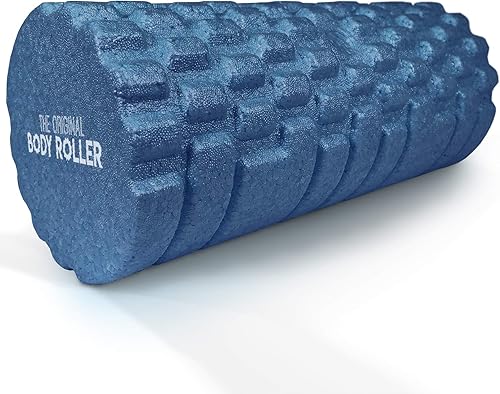
The Original Body Roller: Best textured roller for trigger points
- 12.5 x 5.25 x 5.25 inches
- 3D textured with triple massage zones
- Heavy duty EPP construction
- Blue
A compact textured roller with ridges and spiked bumps for targeted back and leg work. It is lighter and more focused than smooth rollers.
Pros
- Textured zones for targeted pressure
- Very lightweight and portable
- Dual grid design
Cons
- Textured feel may be intense for sensitive users
- Short length limits full back coverage
This Original Body Roller suits users who want textured pressure for trigger point work. It measures 12.5 x 5.25 x 5.25 inches and weighs only 3.21 ounces.
Its 3D textured surface has triple massage zones with ridges and spiked bumps. The brand says the zones replicate fingers, thumbs and palms for focused work on back and leg muscles.
A dual grid design gives you different textures on different sides, so you can choose a ridge pattern or a bump pattern depending on the area.
Heavy duty EPP construction gives a firm base that stays comfortable enough for beginners who start with light pressure. The compact size suits runners and people who roll before or after workouts at home.
Because the diameter is just over 5 inches, pressure feels more focused than on a 6 inch smooth roller.
The trade-off is intensity and coverage. Textured bumps can feel strong on sensitive areas, and the short length limits full back coverage.
For smooth quad work, see best foam roller for quads.
FITNATION Fitizen Foam Roller: Best mini roller for hard to reach spots
- 12 x 4 x 4 inches in this size
- Firm EVA foam
- Textured surface
- Black
A mini 12 by 4 inch textured roller for focused pressure on calves, hamstrings and quads. Its small diameter gives more control around tight areas.
Pros
- Compact mini size for targeted work
- Firm EVA supports consistent pressure
- Easy to fit in a gym bag
Cons
- Narrow 4-inch diameter less stable for balance work
- Textured surface may feel strong
This FITNATION Fitizen roller suits targeted work on hard to reach areas. This size measures 12 x 4 x 4 inches in firm EVA foam with a textured surface.
The narrow 4 inch diameter focuses pressure more than a 6 inch roller. That helps with calves, hamstrings, quads and glutes where you want more control around tight spots.
At 3.2 ounces, it is light enough to fit easily in a gym bag for warm ups and post workout recovery.
FITNATION says the raised surface acts as a trigger point roller for deep tissue work, and the roller is listed for back and legs. The firm EVA foam is described as lightweight but solid, so it provides consistent pressure without losing shape.
That makes short, slow passes over a specific area easier to control.
The trade-off is stability. A narrow roller feels less steady for balance exercises than 6 inch diameter models.
Textured pressure may also feel strong, so beginners should use hand support and short passes at first.
TriggerPoint CORE Foam Massage Roller with Softer: Best softer compression roller
- 12 x 4 x 4 inches in this size
- Soft firmness
- EVA foam
- Multi-density grid pattern
A 12-inch soft roller with a multi-density grid for self-massage and mobility work. Its solid EVA core resists breakdown better than standard polypropylene.
Pros
- Softer compression for gentle massage
- Grid pattern for targeted compression
- Compact 12-inch length
Cons
- Soft feel gives less deep pressure
- Narrow diameter less stable for some exercises
This TriggerPoint CORE roller suits people who want softer compression with a textured pattern. This size measures 12 x 4 x 4 inches in EVA foam with soft firmness.
Its multi density grid pattern gives targeted compression for self massage. TriggerPoint says the solid EVA core is more durable than standard polypropylene rollers that can break down and become soft.
That durability matters if you plan to use the roller often and want the surface to keep its shape over time.
The compact 12 inch length suits most muscle groups and travels easily. Soft compression makes it a gentler option than firm textured rollers for users easing into rolling.
The listed benefits focus on muscle relaxation and increased mobility, which aligns with gentle massage rather than deep pressure.
The trade-off is depth. Softer foam gives less deep pressure for users who want firm deep tissue work.
For stronger pressure, compare our best deep tissue foam roller guide. The narrow diameter also gives less stability for some balance exercises.
Which foam roller for physical therapy should you buy first?
Choose firm and 18 inches if you want one all round tool for controlled rehab exercises. That size covers most leg and back work without demanding a lot of storage space.
Choose soft and 36 inches if you need gentle full body positioning and balance support. The OPTP soft density roller fits that job better than firm models and is a sensible starting point if you are new to rolling.
Choose textured and compact if you want focused trigger point work. Texture is most useful when you already know the areas you want to target and can control pressure with your hands or legs.
A massage gun is a different recovery tool and cannot replace a roller for positioning and balance exercises. If you use a treadmill as part of rehab, first read Can You Use a Treadmill for Physical Therapy?.
How firm should a foam roller for physical therapy be?
Soft density rollers
Soft rollers suit gentle massage, full body positioning and early balance work. They spread pressure across a wider area and feel more comfortable for sensitive users.
The OPTP and TriggerPoint CORE are the gentler options here.
Soft foam also lets you practise the movement pattern for an exercise before adding firm pressure. That can help when a therapist has asked you to work on positioning rather than deep tissue massage.
Firm high-density rollers
Firm rollers suit deep tissue work, myofascial release and later stage rehab exercises. They hold shape under pressure and give stronger pressure for tight areas.
Firm foam is not automatically better. It is better only when the exercise calls for stronger pressure and you can tolerate it without sharp pain.
Some people keep both a soft and a firm roller, then switch based on the exercise.
What length and diameter work best for rehab exercises?
36-inch rollers
Long rollers cover the full back and feel steadier for balance work. They suit Pilates, yoga and supported back exercises at home.
18-inch rollers
Mid length rollers cover most areas without needing much storage. They suit legs, back and core work in small rooms.
12-inch rollers
Short rollers suit travel, feet, calves and targeted areas. They give less stability, so use them mainly for massage rather than balance work.
A 12 inch length packs easily and lets you reach smaller areas without moving a long roller into position.
Diameter also matters. A 6 inch diameter feels steadier than a 4 inch diameter.
A narrower roller focuses more pressure, which can help with tight spots but reduce stability.
For balance and positioning exercises, choose the wider diameter first. For focused work on calves, feet or small muscle groups, a narrower roller can be easier to control.
If you use one roller for both jobs, support your weight with your hands and keep passes slow.
Short rollers also suit small rooms and gym bags. That convenience is the main trade-off against coverage, because longer rollers support more of the back or legs at once.
Pick length by the exercises you do most often, not only by pack size.
What material should you look for in a physical therapy foam roller?
Closed cell EVA foam wipes clean and resists water. It suits clinic and home use where hygiene matters.
EPP foam also resists bending and holds shape under pressure. It suits firm rollers used often for deep tissue work.
Polypropylene rollers maintain shape and wipe clean easily. They suit firm balance and strengthening exercises, with molded edges aimed at comfort during supported work.
Smooth surfaces suit general rolling and controlled pressure. Textured surfaces focus pressure on smaller areas and may feel stronger.
Smooth is easier to control for beginners, while texture helps you find a specific tight spot.
Care and cleaning by material
Wipe down smooth EVA, EPP and polypropylene surfaces after use, especially if shared in a clinic or gym. Let the roller dry fully before storing it, and keep it away from direct heat.
How should you use a foam roller safely during physical therapy?
Start with light pressure and slow passes. Support your weight with your hands or opposite leg so you can control the pressure.
Short, controlled movements make it easier to stay within a comfortable range while you learn how the roller responds.
Stop if you feel sharp pain, numbness or tingling. Those signs mean you should ease off or check with your therapist.
Mild muscle discomfort is different from sharp pain.
Use a soft roller for positioning exercises and a firm roller for massage, as your plan directs. Talk to a doctor or physical therapist if you have ongoing pain, recent surgery or a new injury, especially for bony areas, joints and surgical sites.
Set up on a firm, flat surface so the roller does not travel during use. Keep the movement slow and avoid rushing over a sore area to get through the session faster.
Adjust pressure by changing how much weight you place on the roller. Hands, a wall or the opposite leg can all reduce load at the start.
Increase pressure only as comfort and control allow.
Avoid direct pressure on bony areas such as the spine, ribs, elbows and knees. Target muscle areas instead and keep sessions brief enough that you can stop and reassess.
Clean the surface after regular use and let it dry before storage. A clean, dry roller is easier to grip and safer to reuse, especially in a shared gym or clinic setting.
Verdict: the best foam roller for physical therapy
Pick the Amazon Basics 18-inch high-density roller if you want one firm tool for controlled rehab exercises. Its size, firm polypropylene body and molded edges make it a balanced choice for balance, strengthening and flexibility work at home.
Pick the OPTP PRO-Roller soft density roller if you need gentle 36-inch support for positioning and balance work. Its soft closed cell EVA foam gives a more forgiving surface for full body work.
Pick a textured compact roller if targeted trigger point pressure matters more than full coverage. The Original Body Roller, FITNATION Fitizen and TriggerPoint CORE each approach that job differently, from firm textured pressure to softer grid compression.
Our top 3 picks at a glance
-
1
Best for controlled rehab exercises
Amazon Basics High-Density Foam Roller for Exercise
9.7/10 our score
See it on Amazon -
2
Best for full-length support
Amazon Basics High Density Foam Roller
9.6/10 our score
See it on Amazon -
3
Best for travel and targeted areas
Day 1 Fitness High Density Muscle Foam
9.6/10 our score
See it on Amazon
Frequently asked questions
What firmness is best for a foam roller used in physical therapy?
Many people in controlled rehab work start with a soft or medium roller for positioning and gentle massage. A firm roller suits later stages when you need stronger pressure for deep tissue work.
Choose by comfort and the exercises your therapist recommends, not by pressure alone.
How long should a foam roller be for physical therapy?
A 36-inch roller covers the full back and feels more stable for balance exercises. An 18-inch roller suits most leg and back work at home.
A 12-inch roller works for travel and targeted areas like calves and feet.
Can beginners use a firm foam roller for physical therapy?
Beginners can use firm rollers with light pressure and support from the hands or opposite leg. Start with short, slow passes and stop if you feel sharp pain.
A soft density roller is often an easier starting point for gentle work.
What material lasts longest in a foam roller?
Closed-cell EVA and EPP foams resist water and hold shape under repeated pressure. Polypropylene rollers also maintain shape and wipe clean.
Check the diameter and firmness as well, because density affects how the roller responds to your weight.
When should I talk to a therapist about foam rolling?
Talk to a doctor or physical therapist if you have ongoing pain, recent surgery, or a new injury. They can tell you which areas to avoid and how much pressure is safe.
Foam rolling supports rehab work but does not replace professional care.


