Weighted Vest vs Ankle Weights: Which Should You Choose? (November 2026)
Choose a weighted vest for full-body resistance, or ankle weights for targeted leg and arm exercises. Your workout style, starting load and comfort during movement should guide the choice.
On this page (8 sections)
- Weighted vest vs ankle weights: what is the main difference?
- Which option suits your workout?
- Are ankle weights better for targeted leg work?
- How much resistance should you start with?
- Which equipment is easier to fit?
- Can you use either option for cardio?
- How should you care for wearable weights?
- Which should you choose?
Choose a weighted vest for full-body resistance, or ankle weights for targeted leg and arm exercises. The weighted vest vs ankle weights decision depends on where you want resistance, how much load you need and which movements make up most of your routine.
A vest places weight around your torso, so it can suit squats, lunges, push-ups, walking and running.
Ankle weights attach near the ankle and make leg movements more demanding without adding the same load to your chest and back.
That difference in placement matters more than the headline weight alone.
Weight near your center can change a compound movement in a fairly even way, while weight near the ankle can make a simple leg lift feel much harder.
We compared the listed load ranges, attachment methods and exercise uses for these 4 products.
Our score weighs specs, features and buyer feedback against what you are shopping for.
The CAP vest adjusts from 2.5 to 40 lb, which gives it the widest range in this group.
It suits people who want to start light and increase resistance as strength and conditioning improve.
The ZELUS vest uses fixed options instead, including 6, 8, 12, 16, 20, 25 and 30 lb.
That fixed approach can be simpler if you already know the load you prefer for regular walks or workouts.
Sportneer and APEXUP both adjust from 1 to 5 lb per ankle, with a 10 lb maximum per pair.
Their 1 lb modules make small changes possible, which can help when a movement is new or when you want finer control.
Think about your main exercises first.
If squats, lunges, push-ups and walking fill most of your sessions, a vest is likely to fit your routine better.
If leg raises, controlled hip work, Pilates or selected arm movements matter more, ankle weights may suit your training style.
They add load only where the strap sits, so they do not create the same torso load as a vest.
Fit and comfort should guide the choice as well.
A vest needs a secure torso fit, while ankle weights need a strap that stays in place during repeated movement.
Start with the lightest setting that still challenges the movement.
You can add resistance later once your form stays smooth and your range of motion feels normal.
The right option is the one you can wear consistently and safely for the exercises you actually do.
Extra load is only useful when it supports your routine without changing how you move.
 Best for progressive full-body training
CAP Adjustable Weighted Vest 20–150 lbs
Weighted vest vs ankle weights: what is the main difference?
A weighted vest adds resistance near your body's center, while ankle weights add resistance at the end of each leg. That location changes how the load feels during common exercises.
A vest can make bodyweight movements harder without changing the exercise itself. You can wear one for squats, lunges, push-ups, walking or running, depending on the load and your comfort.
Ankle weights create localized resistance during leg lifts, walking, Pilates, aerobics and similar movements. Some models can also be used as wrist weights, which gives you more options for controlled upper-body exercises.
Compare weighted vests and wrist weights if you are considering resistance on your upper body.
The load range is also different. The CAP vest adjusts from 2.5 to 40 lb, while Sportneer and APEXUP adjust from 1 to 5 lb per ankle.
Which option suits your workout?
Choose a vest for compound movements and cardio, or ankle weights for smaller, targeted movements. Match the equipment to the exercises you already perform well.
A vest can fit a home routine built around squats, lunges, push-ups and conditioning. Compare weighted vest options for workout picks.
The CAP model is designed for whole-body fitness, resistance training, running, walking and workouts.
Ankle weights make more sense when you want to add load to leg raises, controlled hip work, walking or Pilates. Sportneer lists walking, running, yoga, Pilates, rehabilitation and physical therapy among its uses.
If you want broader home equipment ideas, this home strength equipment guide covers resistance bands and other ways to build a flexible routine.
Who should choose the CAP vest?
The CAP vest suits people who want resistance that can grow from 2.5 to 40 lb. Its individual adjustable weights let you change the load as your training changes.
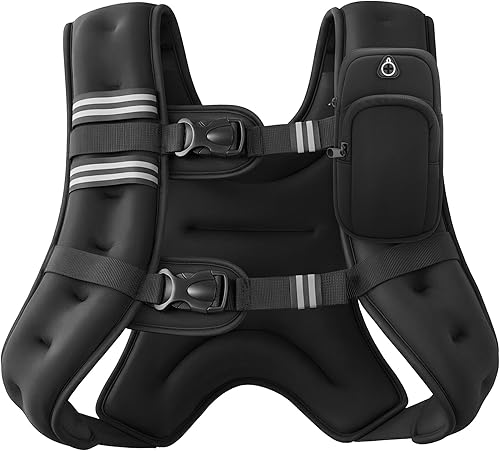
The vest uses a fully adjustable waist belt and padded shoulders. Its reinforced nylon and polyester construction includes reflective stripes for low-light walking or running.
Use it for exercises where a centered load makes sense, such as squats, lunges, push-ups and conditioning. The hook and loop closure gives you a way to secure the vest before you start moving.
Who should choose the ZELUS vest?
The ZELUS vest suits users who want several fixed weight options, storage pockets and a buckle fit. Options include 6, 8, 12, 16, 20, 25 and 30 lb.
It uses neoprene rubber fabric, iron sand, cushioned shoulder straps and adjustable buckle straps. The listed chest fit is 31.5 to 45 inches.
The detachable front zipper pockets can hold small items such as a phone or keys, while the rear elastic-mesh pocket adds another storage area. Reflective stripes support visibility during low-light workouts.
Are ankle weights better for targeted leg work?
Ankle weights are better when you want resistance close to the leg during controlled movement. They are smaller than vests and can be useful when a torso load would not fit the exercise.
Both ankle-weight options here use 1 lb modules. That lets you begin with 1 lb on each ankle and increase the load gradually up to 5 lb on each ankle.
Use a light starting load for movements that lift or swing the leg. Extra weight near the ankle can make a movement feel harder than the same number placed closer to the body.
If you are comparing different models, our guide to the best adjustable ankle weights explains what to check before choosing.
What makes Sportneer different?
Sportneer is the better fit when you want 1 lb adjustments and a specified 7.5 to 12.5 in ankle fit. Each weight has 5 removable iron sand bags, with each bag weighing 1 lb.
The pair adjusts from 2 to 10 lb. The neoprene exterior, reinforced stitching, moisture-absorbing inner material and sturdy outer trim are designed around repeated movement.
Its long hook and loop straps help secure the weights, and the metal D-ring holds the strap in place. Check your ankle perimeter before ordering, especially if you plan to use the weights on the wrist.
For a closer look at the design, read about adjustable ankle weights with metal bars, then compare the attachment style with your preferred exercises.
What makes APEXUP different?
APEXUP suits users who want a compact pair with modular 1 lb increments and ankle or wrist use. Each of the 2 included weights has 5 modules and adjusts from 1 to 5 lb.
The weights use iron sand inside a soft neoprene sleeve. Adjustable Velcro straps support the fit, while the compact design suits yoga, walking, running, aerobics, gym work and physical therapy.
The full pair weighs 10 lb at its listed maximum, with 5 lb on each ankle. Consider it when portability and localized resistance matter more than the wider load range of a vest.
People comparing fit and use cases can also see our guide to the best adjustable ankle weights for women.
How much resistance should you start with?
Start with the lightest load that lets you keep smooth form and a normal range of motion. Add weight only when the current load feels controlled throughout the exercise.
For a vest, that may mean using a low setting before progressing toward heavier resistance. The CAP vest starts at 2.5 lb, while the ZELUS range begins at a 6 lb option.
For ankle weights, start with 1 lb per ankle if that is enough to challenge the movement. Sportneer and APEXUP both support increases in 1 lb steps per weight.
The right load depends on the movement. A slow leg raise may need less weight than a walk, but the best choice is the one that keeps your stride and joint position controlled.
Our guide to adjustable ankle weights from 1 to 5 lb can help if you are choosing a lighter pair.
Which equipment is easier to fit?
A vest needs a secure torso fit, while ankle weights need a secure strap around the ankle or wrist. Fit matters because loose equipment can shift during movement.
The CAP vest uses an adjustable waist belt, padded shoulders and a hook and loop closure. The ZELUS model uses adjustable buckle straps and lists a 31.5 to 45 in chest range.
Sportneer lists a 7.5 to 12.5 in ankle fit and uses long hook and loop straps. APEXUP uses adjustable Velcro straps and is described as one size for all.
Measure before ordering. For ankle weights, check the perimeter where the strap will sit.
For a vest, compare your chest measurement with the stated range when one is available. For extended sizing, see XXL weighted vest sizing.
Can you use either option for cardio?
Both can add resistance to walking or running, but a vest is usually the more natural match for full-body cardio. Ankle weights place load farther down the leg, so they need a cautious starting point.
The CAP vest is intended for running, walking and cardio workouts. Its reflective stripes also support visibility during low-light activity.
The ZELUS vest includes a reflective stripe and lists running, fitness, strength training and weight loss among its uses. Its buckle straps help you secure the vest before movement.
Sportneer and APEXUP list walking and running among their uses. Use a light ankle load first and stop if the weights change your stride or make the movement feel uneven.
You can pair wearable weights with other home equipment. For cardio planning, see Best Treadmill For Weight Loss and check How to Choose the Right Treadmill Size? before setting up a treadmill space.
How should you care for wearable weights?
Keep the straps secure, remove the weights carefully and store each item dry between workouts. General care helps preserve the closure and the outer material.
Check the hook and loop, buckle or Velcro closure before each session. Make sure the weight sits where intended and that no strap edge is folded under pressure.
For modular ankle weights, remove or add the 1 lb modules evenly when using a pair. Keep loose modules together so you can set the same load on both sides.
For either type, wipe away moisture after use and follow the care directions for the material. Avoid changing the construction or filling beyond the intended adjustment system.
If you use resistance bands alongside wearable weights, this guide to fabric resistance bands with handles explains another way to add adjustable resistance without loading the ankles.
Which should you choose?
Pick the CAP vest if you want the widest adjustable range for full-body workouts. Its 2.5 to 40 lb resistance, adjustable belt and padded shoulders make it the clearest choice for progressive training.
Pick the ZELUS vest if fixed weight options, reflective details and storage pockets matter more.
Choose Sportneer for adjustable ankle resistance with a specified 7.5 to 12.5 in fit, or APEXUP for compact 1 lb modules that can also be used on the wrists.
For the CAP vest, the main benefit is progression.
You can begin near the low end and move upward as squats, lunges, push-ups and conditioning become easier.
Its adjustable waist belt and padded shoulders help spread the load across the torso.
The hook and loop closure also gives you a simple way to secure the vest before each session.
The trade-off is that a vest adds load to your full body rather than a single joint.
That can suit compound movements, but it may not be the best match for small, isolated leg exercises.
The ZELUS vest suits a different training style.
Its fixed weights remove the need to adjust small packets, and its buckle straps suit a chest range of 31.5 to 45 in.
Neoprene, iron sand and cushioned shoulder straps shape the feel of this option.
The detachable front zipper pockets and rear elastic-mesh pocket can hold small items such as a phone or keys during a workout.
Reflective details on both vest options can help with low-light walking or running.
They do not replace good visibility, but they can make evening sessions feel more secure.
Sportneer suits people who want to change ankle load in 1 lb steps.
Each weight includes 5 removable iron sand bags, so you can remove one or two bags if the full load feels too heavy.
Its neoprene exterior, reinforced stitching and moisture absorbing inner material support repeated use.
The long hook and loop straps and metal D-ring help keep the strap in place during movement.
APEXUP offers a similar 1 to 5 lb range per ankle in a compact form.
The soft neoprene sleeve and adjustable Velcro straps suit yoga, walking, running, aerobics, gym work and physical therapy.
Both ankle options top out at 10 lb per pair.
Check that both sides carry the same load and that the strap sits evenly before you start.
For either choice, keep the closure clean and check for wear before regular use.
Store the item dry and handle the weight packets or modules with care.
Frequently asked questions
Is a weighted vest better than ankle weights?
A weighted vest is better for adding resistance to full-body exercises such as squats, lunges, push-ups, walking and running. Ankle weights are better for targeted leg work and some arm exercises.
Choose the option that places resistance where your planned movements can handle it comfortably.
Can you use ankle weights for walking?
You can use adjustable ankle weights for walking, but start with a light load and pay attention to your stride. Sportneer and APEXUP both adjust from 1 to 5 lb per ankle.
Remove weight if your movement becomes uneven or uncomfortable.
What is the best adjustable weighted vest here?
The CAP Adjustable Weighted Vest is the strongest fit for progressive full-body training because its resistance adjusts from 2.5 to 40 lb. The ZELUS vest suits people who prefer a fixed weight option, buckle straps and storage pockets.
Can ankle weights replace a weighted vest?
Ankle weights can add resistance to selected exercises, but they do not distribute load across your torso like a vest. Use ankle weights for targeted movement and a weighted vest for exercises that benefit from evenly placed whole-body resistance.