9 Best Finger Heart Rate Monitors (November 2026)
The best finger heart rate monitors include the Zacurate Pro Series 500DL Fingertip Pulse Oximeter for fast resting pulse checks, the Zacurate 500 Series Fingertip Pulse Oximeter Blood for gym bag portability, and the Santamedical Fingertip Pulse Oximeter for pulse bar graph feedback.
On this page (7 sections)
- The best finger heart rate monitors for resting pulse checks
- How the best finger heart rate monitor picks were compared
- How accurate is a fingertip pulse reading?
- Which display is easiest to read after a workout?
- AAA batteries or rechargeable: which is better?
- Which fingertip monitor fits larger fingers or kids?
- Verdict: which best finger heart rate monitor should you buy?
The best finger heart rate monitor for most people is the Zacurate Pro Series 500DL, because it pairs a large user-facing LED display with a 10-second spot check and a cover, batteries and lanyard in the box. You do not need to choose a wrist wearable for a quick resting pulse check after a workout.
A fingertip device clips on, shows your pulse rate and blood oxygen saturation, and fits in a gym bag.
Our score weighs specs, features and buyer feedback against what you are shopping for. These nine models all do the same core job, so small differences matter.
Display size, battery type, extra data like perfusion index or respiration rate, and fit decide which one you will actually use.
Start with a broader heart rate monitor guide if you are comparing fingertip devices with chest straps and wrist wearables. If you want a routine for checking at home, how to monitor heart rate at home walks through timing and hand position.
Our picks at a glance
-
1
 Best for fast resting pulse checks
Zacurate Pro Series 500DL Fingertip Pulse Oximeter
9.6/10 our score
See it on Amazon -
2
 Best for gym bag portability
Zacurate 500 Series Fingertip Pulse Oximeter Blood
9.5/10 our score
See it on Amazon -
3
 Best for pulse bar graph feedback
Santamedical Fingertip Pulse Oximeter
9.4/10 our score
See it on Amazon
- 4
 Check it
CHOICEMMed Finger Pulse Oximeter
Best for longer battery life - 5
 Check it
Amemo Fingertip Pulse Oximeter with Plethysmograph
Best for extra display data - 6
 Best for buttonless simplicityCheck it
- 7
 Check it
easy@Home Fingertip Pulse Oximeter
Best for rotating display views - 8
 Check it
ACMC Rechargeable Pulse Oximeter with Respiration
Best for respiration rate tracking - 9
 Check it
Aranzo Pulse Oximeter with Respiration and OLED
Best for quick OLED readings
The best finger heart rate monitors for resting pulse checks
The Zacurate Pro Series 500DL leads for everyday spot checks, while the other picks trade display data, battery type or charging for different priorities. Choose by how you plan to use it before you compare extra features.
Zacurate Pro Series 500DL Fingertip Pulse Oximeter: Best for fast resting pulse checks
- SpO2, pulse rate and pulse strength in 10 seconds
- Large LED display facing the user
- Silicone cover, batteries and lanyard included
- 2.25 x 1.25 x 1.25 in, 3.2 oz
A compact fingertip oximeter with a user-facing LED display, included batteries and a protective silicone cover.
Pros
- Large LED display faces the user
- Cover and lanyard included
- SpO2 reads up to 100%
Cons
- AAA batteries, not rechargeable
- Made for ages 12 and above
The Zacurate Pro Series 500DL suits people who want a quick resting pulse check without learning a new app or wearing a strap. It reads SpO2, pulse rate and pulse strength in 10 seconds on a large LED display that faces you.
That user-facing screen matters after a workout, when you may be seated and holding the device in one hand. You can read the number without turning the oximeter around or asking someone else to check it.
At 2.25 x 1.25 x 1.25 inches and 3.2 ounces, it slips into a pocket or gym bag. A silicone cover helps protect it from dirt and knocks, and a lanyard keeps it within reach.
The box includes 2 AAA batteries, so it works right away. Battery life is 30 hours, and the finger chamber uses a SMART Spring System for ages 12 and above.
Zacurate backs it with a 12-month warranty and USA based technical phone support. The trade-off is that it uses disposable AAA batteries instead of a rechargeable cell, and it is for sports and aviation use only, not medical use.
Zacurate 500 Series Fingertip Pulse Oximeter Blood: Best for gym bag portability
- SpO2 70-100%, pulse 30-250 BPM
- Large digital LED display
- Silicon cover, batteries and lanyard
- 30 hours battery life
A black fingertip oximeter with a wide pulse range and accessories that make it ready to carry after a workout.
Pros
- Pulse range listed to 250 BPM
- Accessories included
- Compact 3.2 oz design
Cons
- AAA batteries, not rechargeable
- Reading can be affected by low blood perfusion
The Zacurate 500 Series suits gym members who want a black, easy to carry fingertip oximeter for post-workout checks. It reads SpO2, pulse rate and pulse strength in 10 seconds on a large LED display.
Its listed pulse range runs from 30 to 250 BPM, with SpO2 from 70% to 100%. That wide pulse range covers resting checks and higher readings after exercise without switching devices.
At 3.2 ounces and 2.25 x 1.25 x 1.25 inches, it is small enough for a gym bag side pocket. The silicon cover, lanyard and 2 AAA batteries are included, so you can use it from the first day.
The finger chamber uses the same SMART Spring System concept for a wide range of finger sizes, for ages 12 and above. Battery life is 30 hours on the included batteries.
Zacurate provides a 1-year warranty and USA based technical phone support. The main trade-off is lower blood perfusion can affect accuracy, so warm your hands and keep still.
Like the top pick, it is for sports and aviation use only, not medical use.
Santamedical Fingertip Pulse Oximeter: Best for pulse bar graph feedback
- SpO2, pulse rate and pulse bar graph
- Results in 8 to 10 seconds
- Batteries and carry case included
- 30+ hours on one set of batteries
A lightweight fingertip oximeter that adds a pulse bar graph and a carry case to a simple one-button design.
Pros
- Pulse bar graph for visual feedback
- Carry case included
- Lightweight 2.4 oz design
Cons
- Red LED display, not OLED
- AAA batteries, not rechargeable
The Santamedical Fingertip Pulse Oximeter suits buyers who like a visual pulse cue in addition to a number. It shows SpO2, pulse rate and a pulse bar graph on a large red LED display in 8 to 10 seconds.
The bar graph gives you a quick sense of pulse strength without decoding extra numbers. That can help you spot a weak signal and adjust your hand position before you trust the reading.
At 2.4 ounces and 3.2 x 2.5 x 1.9 inches, it is light and portable for home or outdoor use. A carry case and neck or wrist cord are included, along with 2 AAA batteries and a user manual.
Santamedical says it provides 30+ hours of continuous monitoring on one set of batteries. Auto power off and low power consumption help preserve that charge between spot checks.
The finger chamber is designed for a range of finger sizes and uses latex free silicone material. The trade-off is a red LED display rather than an OLED screen, and AAC batteries instead of a rechargeable cell.
CHOICEMMed Finger Pulse Oximeter: Best for longer battery life
- SpO2 and pulse rate in about 10 seconds
- Up to 40 hours battery life
- Carry case and lanyard included
- Automatic power-off
A blue fingertip oximeter with 40 hours of battery life and a carry case for travel or outdoor use.
Pros
- Longest stated battery life here
- Carry case and lanyard included
- One-button operation
Cons
- AAA batteries, not rechargeable
- LED display, not OLED
The CHOICEMMed Finger Pulse Oximeter suits travelers and outdoor users who do not want to swap batteries often. It measures SpO2 and pulse rate in about 10 seconds, with a pulse strength indicator on a bright LED display.
Battery life is up to 40 hours, the longest stated figure in this group. That matters if you keep the device in a backpack for hikes, cycling or high altitude trips and use it for occasional spot checks.
One-button operation keeps the routine simple. Insert your finger, press the power button, and read SpO2, pulse rate and pulse strength.
Automatic power off helps save charge.
The package includes a carrying case, adjustable lanyard, user manual and 2 AAA batteries. At 3.21 ounces, it fits easily into pockets and travel bags.
CHOICEMMed says it is designed for mountain climbers, cyclists, runners, hikers and pilots who want spot checks during activities. The trade-off is AAA batteries rather than a rechargeable cell, and it is not intended for medical use.
Amemo Fingertip Pulse Oximeter with Plethysmograph: Best for extra display data
- Plethysmograph and perfusion index
- 1.2-inch OLED display
- Results in as little as 3 seconds
- Alarm function for SpO2 and heart rate
A red-orange fingertip oximeter with a larger OLED screen, waveform display and alarm settings.
Pros
- Larger 1.2-inch OLED display
- Plethysmograph and perfusion index
- Fast 3-second readings
Cons
- Alarm setup uses a long press
- AAA batteries, not rechargeable
The Amemo Fingertip Pulse Oximeter with Plethysmograph suits buyers who want more than a single pulse number. It shows SpO2, pulse rate, pulse intensity, a pulse waveform and battery level.
A 1.2-inch OLED display is larger than the 0.9-inch screens Amemo compares against, so numbers are easier to read at a glance. That helps if you check your pulse while seated after a workout and do not want to squint.
Amemo says readings can arrive in as little as 3 seconds. It also offers an alarm function, so you can set SpO2 and heart rate thresholds for use during exercise or sleep.
The package includes a carrying case, two batteries, a lanyard and a user manual. At 2.4 x 1.3 x 1.2 inches, it remains compact for a gym bag or drawer.
Setup uses one button, with a long press for 2 seconds to enter settings. That is simple, but it takes practice.
The trade-off is AAA batteries instead of a rechargeable cell, and the measuring range is 70% to 100% SpO2.
LBEAURG Finger Pulse Oximeter: Best for buttonless simplicity
- No-button reading in 5-8 seconds
- Rechargeable with USB cable
- Large LED display
- Auto power-off when finger is removed
A green rechargeable fingertip oximeter that starts a reading when you insert your finger, with no button to press.
Pros
- Buttonless operation
- Rechargeable design
- Auto power-off
Cons
- Battery life stated as standby time
- No alarm function listed
The LBEAURG Finger Pulse Oximeter suits people who want the simplest possible routine. There is no button to press.
You insert your finger and get a reading in 5 to 8 seconds on a large LED display.
That buttonless design removes one step, which helps if you hand the device to a family member or use it while your other hand is busy. Auto power off after you remove your finger also saves charge.
It is rechargeable, with a USB cable included in the package along with a wrist cord and user manual. LBEAURG says one charge gives one month of standby time, which suits occasional spot checks at home.
The body uses high-density ABS plastic with a soft silicon pad for comfort. At a small portable size, it is easy to carry for outdoor sports, mountain climbing or aviation related spot checks.
The trade-off is that standby time is not the same as active use time, and no alarm function is listed. It is intended for sports and aviation use only, not for medical use.
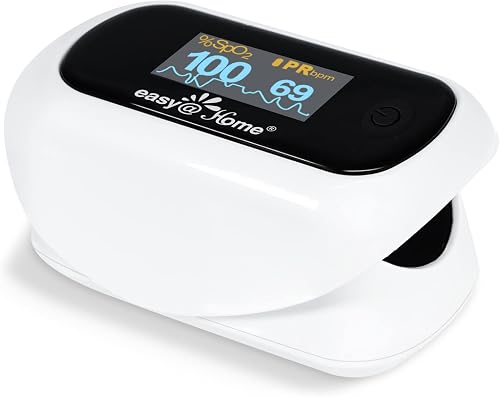
easy@Home Fingertip Pulse Oximeter: Best for rotating display views
- Rotatable OLED display in 4 directions
- 10 brightness levels
- Plethysmograph waveform and bar graph
- More than 24 hours on 2 AAA batteries
A white fingertip oximeter with a rotating OLED display, adjustable brightness and multiple display modes.
Pros
- Rotating display fits your viewing angle
- Adjustable brightness
- Waveform and bar graph views
Cons
- AAA batteries, not rechargeable
- Keep still during measurement
The easy@Home Fingertip Pulse Oximeter suits buyers who read the screen from different angles. Its OLED display rotates in four directions, so you do not need to twist the device to see the numbers.
You can also adjust brightness across 10 levels by holding the power button. That helps outdoors in bright light or indoors at night, when a fixed brightness screen can be too dim or too harsh.
It measures SpO2, pulse rate and pulse intensity in 8 seconds or less. A plethysmograph waveform and bar graph give visual feedback on pulse strength, which can help you tell if the signal is weak.
The package includes a lanyard, carrying package, 2 AAA batteries and US technical telephone support. Battery life is more than 24 hours of continuous use, with auto power off within 8 seconds of nonuse.
Seven display modes cover different viewing needs. The trade-off is that you need to keep still during measurement, and it uses AAA batteries rather than a rechargeable cell.
ACMC Rechargeable Pulse Oximeter with Respiration: Best for respiration rate tracking
- SpO2, pulse rate, perfusion index and respiration rate
- Pink OLED display
- Rechargeable with Type-C charging
- Readings in 5 seconds
A rechargeable fingertip oximeter that adds respiration rate to SpO2, pulse rate and perfusion index on a rotating OLED screen.
Pros
- Respiration rate tracking
- Rechargeable Type-C design
- Rotating OLED display
Cons
- Fewer buyer reports than the top picks
- For sports and aviation use only
The ACMC Rechargeable Pulse Oximeter with Respiration suits buyers who want respiration data along with pulse. It tracks SpO2, pulse rate, perfusion index and respiration rate in 5 seconds.
Respiration rate adds context that most fingertip models here do not provide. If you compare readings at rest and after activity, that extra number can help you see how your breathing settled along with your pulse.
A pink OLED display rotates 360 degrees, so you can view it at any angle. ACMC says it stays readable in direct sunlight or complete darkness, which helps for travel or outdoor use.
Type-C charging removes the need to buy replacement batteries. The flexible finger chamber comfortably accommodates a wide range of finger sizes, from teens to adults.
The trade-off is fewer buyer reports than the top picks, and it is for sports and aviation use only. Its SpO2 range is 70% to 100%, and it slips easily into a backpack or gym bag for on the go checks.
Aranzo Pulse Oximeter with Respiration and OLED: Best for quick OLED readings
- SpO2, pulse rate, perfusion index and respiration rate
- Results within 4 seconds
- OLED display
- Soft silicone padding
A blue fingertip oximeter with respiration rate, a high-contrast OLED display and a curved cavity for comfort.
Pros
- Fast 4-second readings
- Respiration rate included
- Comfortable curved cavity
Cons
- No rechargeable design listed
- For sports and aviation use only
The Aranzo Pulse Oximeter with Respiration and OLED suits buyers who want fast readings and respiration data in a compact device. It displays SpO2, pulse rate, perfusion index and respiration rate within 4 seconds.
ACMC style motion resistance is listed here as well, with motion-resistant technology that keeps readings accurate even when you move. That can help if your hand is not perfectly still after exercise.
A high-contrast OLED display keeps numbers clear in bright and dim lighting. Soft silicone padding and a curved cavity make the fit more comfortable for fingers of different sizes.
At a lightweight, portable size, it works at home, outdoors or during travel. It suits people who check pulse and oxygen after a run, hike or flight and want a quick, stable result.
The trade-off is that no rechargeable design is listed, and it is for sports and aviation use only, not medical use. Its SpO2 range is 70% to 100%, with accuracy listed as SpO2 plus or minus 2% and pulse rate plus or minus 1 bpm.
How the best finger heart rate monitor picks were compared
We compared specs, features and buyer feedback for fingertip devices built for spot checks. We looked at display type, battery life, charging, measuring range and what each model includes in the box.
We also checked how each device handles fit and signal quality. A fingertip oximeter needs a secure clip, a readable screen and a reading that arrives before your hand gets tired.
Wrist wearables and chest straps solve a different problem. If you want continuous tracking during a workout, our best heart rate monitor daily use guide covers that use case better.
For ECG style readings, fingertip oximeters are the wrong tool. Our best heart rate monitor with ekg guide explains which devices provide that data.
How accurate is a fingertip pulse reading?
A fingertip oximeter reads SpO2 and pulse rate from light passing through your finger. Most models here state accuracy of plus or minus 2% for SpO2, and readings arrive in 3 to 10 seconds.
Accuracy drops when your fingers are cold, your circulation is poor, or you move during the reading. Warm your hands first and keep still until the number stabilizes.
Nail polish, artificial nails and strong external light can also affect the result. Remove polish before a reading if the number looks off, and shield the sensor from bright light.
What numbers should you expect at rest?
CHOICEMMed notes that SpO2 is often considered to range from 95% to 99% for many people, and resting pulse rate is often considered to range from 60 to 100 beats per minute. Your own normal range depends on your health and altitude.
Treat a fingertip reading as a spot check, not a diagnosis. If readings are consistently low or you feel unwell, talk with a health professional.
Which display is easiest to read after a workout?
A large LED or OLED display matters more than extra colors. The Zacurate models face the display toward you, while easy@Home and ACMC rotate the screen to fit your angle.
OLED screens like the Amemo, easy@Home, ACMC and Aranzo tend to give higher contrast in bright light. LED screens like the Zacurate, Santamedical, CHOICEMMed and LBEAURG are simple and clear for quick checks.
The Amemo adds a plethysmograph waveform and perfusion index on a 1.2-inch OLED screen. That extra data helps you judge signal quality, not just the final number.
Do you need a waveform or bar graph?
A pulse bar graph, found on the Santamedical and easy@Home, shows pulse strength at a glance. A waveform shows the pattern of each beat.
For a simple resting check, the number is usually enough. For judging whether a low reading is real or just a weak signal, the graph helps.
AAA batteries or rechargeable: which is better?
AAA batteries win for travel and backup. The Zacurate, Santamedical, CHOICEMMed, Amemo and easy@Home models ship with batteries and run for 24 to 40 hours.
Rechargeable models like the LBEAURG and ACMC remove ongoing battery costs. You charge them with a USB cable or Type-C port and keep them ready in a drawer.
Choose AAA batteries if you want to swap a fresh set anywhere. Choose rechargeable if you will use the device often at home and prefer one cable.
How long does the battery actually last?
CHOICEMMed states up to 40 hours, the longest figure here. Zacurate states 30 hours, Santamedical states 30+ hours, and easy@Home states more than 24 hours.
Auto power off on several models helps stretch that time between spot checks. High brightness on OLED models can reduce battery life, so lower it if you check often.
Which fingertip monitor fits larger fingers or kids?
Most models here use a spring clip designed for a wide range of finger sizes, for ages 12 and above. The Zacurate and LBEAURG state that age range directly.
The Aranzo uses a curved cavity and soft silicone padding for comfort across finger sizes. The ACMC uses a flexible finger chamber for teens to adults.
If the clip feels too tight or too loose, the reading may suffer. Try a different finger and keep your hand at about heart level for a steadier signal.
Can you use it for swimming or treadmill workouts?
Fingertip oximeters are spot check devices, not continuous monitors. They clip on for a reading and come off between checks.
For treadmill training, a chest strap or wrist wearable tracks continuously during the workout. Our best heart rate monitor for treadmill workouts guide covers those options.
For water activities, fingertip devices are not built for continuous wear in the pool. Our best heart rate monitor for swimming guide explains which trackers handle water.
You can still use a fingertip oximeter after a treadmill session to check your resting pulse recovery. Our article on what is a good treadmill heart rate zone for cardio helps you interpret the numbers you see during training.
Verdict: which best finger heart rate monitor should you buy?
Pick the Zacurate Pro Series 500DL if you want the best all-around fingertip device. Its large user-facing LED display, 10-second reading and included cover, batteries and lanyard cover daily use well.
Pick the CHOICEMMed if battery life is your top concern. Its 40 hours of battery life and carry case suit travel and outdoor use.
Pick the Amemo if you want the most display data. Its plethysmograph, perfusion index and larger OLED screen help you judge signal quality.
Pick the ACMC or Aranzo if respiration rate matters to you. Both add that data point to SpO2, pulse rate and perfusion index.
Pick the LBEAURG if you want no buttons and no battery swaps. Its buttonless, rechargeable design is the simplest routine here.
For most readers, the best finger heart rate monitor is the one you will use for a quick check after a workout. Start with the Zacurate Pro Series 500DL, and step up to the Amemo or ACMC only if you want extra data on the screen.
Our top 3 picks at a glance
-
1
Best for fast resting pulse checks
Zacurate Pro Series 500DL Fingertip Pulse Oximeter
9.6/10 our score
See it on Amazon -
2
Best for gym bag portability
Zacurate 500 Series Fingertip Pulse Oximeter Blood
9.5/10 our score
See it on Amazon -
3
Best for pulse bar graph feedback
Santamedical Fingertip Pulse Oximeter
9.4/10 our score
See it on Amazon
Frequently asked questions
What does a finger heart rate monitor actually measure?
A fingertip device clips over your finger and reads pulse rate, blood oxygen saturation and often pulse strength. It gives a spot check at rest, not continuous tracking like a chest strap or wrist wearable.
When should you use a fingertip oximeter after a workout?
Wait until you are seated and calm, keep your hand still and at about heart level, and warm your fingers first. Cold hands, movement and nail polish can affect the reading.
Is a fingertip oximeter a blood pressure monitor?
No. A fingertip oximeter reads pulse rate and SpO2.
It does not measure blood pressure.
Our guide to heart rate monitor vs blood pressure monitor explains the difference in plain terms.