9 Best Manual Treadmill for Running (November 2026)
The best manual treadmills for running include the NordicTrack T Series Treadmills for Home for powered running with incline, the AKLUER Dual Flywheel Manual Treadmill for compact manual running, and the Sunny Health & Fitness Manual Walking Treadmill for quiet incline training.
On this page (6 sections)
- The best manual treadmill for running by training goal
- What should you look for in a manual treadmill for running?
- Are curved manual treadmills better for running?
- How do you use a manual treadmill safely for running?
- Is a manual treadmill good for running?
- Final verdict on the best manual treadmill for running
The best manual treadmill for running is the SB Fitness Equipment CT400 for experienced runners who want a long curved deck, self-generated power and no maximum speed. The ERGOLIFE is the better compact curved option, while AKLUER is a smaller manual choice with a stated speed of up to 12 MPH.
Manual running suits people who already know how to pace themselves and who enjoy responding to effort rather than pressing a button. The belt moves only when your feet push it, so stride, balance and focus shape every session from the first step.
Deck size is the first filter to apply. A 60 x 18 in curved deck gives long strides room to land and recover, while a 36 x 15 in deck asks for shorter steps and more frequent checks on foot position.
Width matters too, especially when you are learning to steer the belt with small shifts in pressure.
Storage is the second filter. A commercial style self powered treadmill needs permanent floor space, while a folding curved or flat model can move into a corner or under furniture between sessions.
Measure length, width and height before you order, and leave clearance to step on and off safely.
If you want buttons, preset workouts or a powered pace, compare the manual picks with the Best Treadmill For Running guide.
Our picks at a glance
-
1
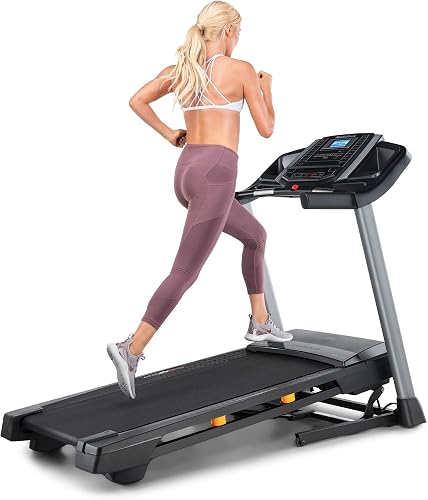 Best for powered running with incline
NordicTrack T Series Treadmills for Home
9.7/10 our score
See it on Amazon -
2
 Best for compact manual running
AKLUER Dual Flywheel Manual Treadmill
9.7/10 our score
See it on Amazon -
3
 Best for quiet incline training
Sunny Health & Fitness Manual Walking Treadmill
9.6/10 our score
See it on Amazon
- 4
 Check it
Pcrignbm Treadmills for Home Walking Pad Machine
Best for small-space powered running - 5
 Check it
CURSOR 40% Incline Treadmill with 15" Deck
Best for steep incline work - 6
 Check it
Yuejiqi Treadmill with Manual 10%/Auto 25% Incline
Best for mixed home cardio - 7
 Check it
LONTEK 18% Incline Treadmills for Home
Best for high-capacity incline walking - 8
 Check it
SB Fitness Equipment CT400 Self Generated Curved Commercial
Best for serious self-powered running - 9
 Check it
ERGOLIFE Curved Treadmill with Non-Electric Motorized
Best for foldable curved running
The best manual treadmill for running by training goal
The best manual treadmill for running depends on whether you want a curved self-powered deck, a compact fixed-incline design or a powered treadmill for controlled pace work. We compared deck dimensions, resistance or incline, speed control, capacity and storage features.
Our score weighs specs, features and buyer feedback against what you're shopping for. The first two picks are the closest matches for nonmotorized running, while the powered models help show where manual treadmills trade convenience for control.
| Product | Best for | Deck | Speed | Incline | Our score |
|---|---|---|---|---|---|
| NordicTrack T Series Treadmills for Home | powered running with incline | 55 x 20 in | 0–10 MPH | 0–10% | 9.7 |
| AKLUER Dual Flywheel Manual Treadmill | compact manual running | 36 x 15 in | Up to 12 MPH | 9.7 | |
| Sunny Health & Fitness Manual Walking Treadmill | quiet incline training | 42.1 x 12.6 in | 14% fixed | 9.6 | |
| Pcrignbm Treadmills for Home Walking Pad Machine | small-space powered running | 0.6–6.2 MPH | 9.6 | ||
| CURSOR 40% Incline Treadmill with 15" Deck | steep incline work | 0%, 10%, 20%, 30% or 40% | 9.3 | ||
| Yuejiqi Treadmill with Manual 10%/Auto 25% Incline | mixed home cardio | 0.8–8.5 MPH | 9.2 | ||
| LONTEK 18% Incline Treadmills for Home | high-capacity incline walking | 0.6–7.5 MPH | 0–18% | 8.9 | |
| SB Fitness Equipment CT400 Self Generated Curved Commercial | serious self-powered running | 60 x 18 in | 8.5 | ||
| ERGOLIFE Curved Treadmill with Non-Electric Motorized | foldable curved running | Up to 22 km/h | 8.3 |
NordicTrack T Series Treadmills for Home: Best for powered running with incline
- 0–10 MPH speed range
- 0–10% incline
- 55 x 20 in deck
- KeyFlex cushioning
- Foldable frame
This is a powered treadmill rather than a manual model, but its long, wide deck and 0–10 MPH range make it a useful reference for runners comparing running space and training control.
Pros
- Longest stated deck in this group
- 0–10% incline
- Foldable frame
Cons
- Requires power
- iFIT features require an iFIT Train Membership
NordicTrack is not a manual treadmill, but it provides the most controlled powered running setup in this group. The 55 x 20 in deck gives you more length and width than the compact manual models, which can make pace work easier for runners who prefer a consistent moving belt.
Its speed range reaches 10 MPH, and the incline runs from 0% to 10%. KeyFlex cushioning is designed to reduce joint impact, while the foldable frame helps when the treadmill must share space with other home equipment.
For more running options that prioritize cushioning, see cushioned treadmills for running.
The LCD display is 5 in, and the treadmill connects through a power cord. iFIT features, including automatic speed and incline changes, require an iFIT Train Membership.
Choose NordicTrack if you want running-deck space, powered speed control and adjustable incline. Choose a self-powered curved treadmill instead if your priority is controlling the belt with your own stride.
AKLUER Dual Flywheel Manual Treadmill: Best for compact manual running
- Dual flywheel
- Fixed incline
- 36 x 15 in deck
- 330 lb capacity
- Foldable non-electric design
AKLUER pairs a dual flywheel with a compact 36 x 15 in deck and fixed incline. It suits runners who want manual resistance and easy storage, but the short deck needs careful stride control.
Pros
- No power outlet needed
- Dual flywheel resistance
- 330 lb maximum weight recommendation
Cons
- Shorter deck for running
- Fixed incline
AKLUER is the most compact manual option here with a stated speed of up to 12 MPH. Its 36 x 15 in running deck and fixed incline favor short, deliberate sessions where you keep your feet centered and control the belt rhythm.
The dual flywheel adds resistance as your effort rises. That means a gentle walk feels light, while stronger pushes meet more drag without any need for a power cord or outlet in your room.
An LCD tracks distance, speed and time, while the non-slip belt and foam grips support basic balance during walking or jogging. Keep the belt clean after use, since sweat and dust can reduce traction and make the surface feel slick.
AKLUER folds to 20.97 x 9.84 x 5.9 in and has a 330 lb maximum weight recommendation. It uses manual power, so it doesn't need a power outlet and can move between rooms with little fuss.
The short deck is the main trade-off for running. Pick it for compact storage and manual resistance, but measure your natural stride and start with walking before trying faster work.
Sunny Health & Fitness Manual Walking Treadmill: Best for quiet incline training
- 14% fixed incline
- 42.1 x 12.6 in deck
- Dual flywheel
- Bluetooth
- Foldable design
Sunny Health & Fitness gives manual training a longer deck than AKLUER, a 14% fixed incline and a dual flywheel. It is better suited to incline walking and short controlled jogs than long running strides.
Pros
- Longer manual deck than AKLUER
- 14% fixed incline
- Bluetooth connectivity
Cons
- Narrow 12.6 in deck
- Fixed incline limits adjustment
Sunny Health & Fitness suits runners who want a manual treadmill with more incline emphasis and a 42.1 in deck. Its 14% fixed incline and dual flywheel make it better for hill-style walking and short jogging sessions than flat, long-distance running.
The deck is 12.6 in wide, so you need to stay aware of foot placement. Narrow decks reward a steady, centered stride and punish drifting steps, so practice at walking pace first and build time before you add jogging effort.
The LCD monitor tracks time, speed, distance and calories, and Bluetooth connects the treadmill to smart devices. A device holder keeps a phone in view, which helps when you follow a guided session or watch your pace change.
The frame folds, transportation wheels help with movement, and the unit includes lubricant, a tool kit, a treadmill and a user manual. Its maximum weight recommendation is 330 lb, and the quick stop mat adds a measure of safety for beginners.
Choose Sunny for quiet manual incline work and compact storage. If you need a wider running surface, the CT400 has an 18 in deck.
Pcrignbm Treadmills for Home Walking Pad Machine: Best for small-space powered running
- 0.6–6.2 MPH speed range
- 39 x 15 in belt
- 2.5 HP peak motor
- 12 preset programs
- Folded size of 45.08 x 21.85 x 5.2 in
Pcrignbm is motorized, not manual, and its 6.2 MPH top speed fits walking, jogging and lighter running. Its thin folded profile helps when storage matters more than a long running deck.
Pros
- 12 preset programs
- 39 x 15 in belt
- Thin folded profile
Cons
- Not self-powered
- Lower stated capacity than several picks
Pcrignbm is a powered treadmill for small homes, not a manual running machine. Its 39 x 15 in belt, 0.6–6.2 MPH range and 2.5 HP peak motor fit walking, jogging and lighter running when you want motor assistance.
The 3.5 in LED display shows time, distance, calories and speed. Twelve preset programs and 3 countdown modes add structure without requiring self-powered belt movement, and the controls let you hold a steady pace from the start.
The folded size is 45.08 x 21.85 x 5.2 in, and the treadmill weighs 55 lb. It supports up to 220 lb and includes a user manual, so check that limit carefully if a household shares the machine.
Care is simple but not optional. Wipe the belt after use, apply silicone oil as the manual directs, and keep the motor vents clear so the belt runs smoothly and quietly over time.
Choose Pcrignbm when thin storage and powered movement matter more than manual training. For a true self-powered running experience, move to the curved CT400 or ERGOLIFE.
CURSOR 40% Incline Treadmill with 15" Deck: Best for steep incline work
- 0–40% manual incline settings
- 38.6 x 15.4 in belt
- 350 lb capacity
- 51 in tall handrails
- Foldable design
CURSOR is built around steep incline training, with 5 manual incline settings up to 40% and tall handrails. Its 38.6 in belt can support controlled jogging, but the incline focus is stronger than its flat-running use.
Pros
- 40% maximum incline
- 350 lb maximum weight recommendation
- Tall handrails
Cons
- Shorter belt than a full running treadmill
- Steepest setting raises the deck 15 in
CURSOR is the incline specialist in this roundup. Its 5 manual incline settings reach 40%, and the deck reaches a 15 in height at the maximum slope, making it suited to steep hill and stair-style training.
The belt measures 38.6 x 15.4 in, and the 51 in handrails are designed to support a more upright posture for taller users. Longer rails give you a place to hold during steep walking without leaning too far forward.
The reinforced base includes foldable front support feet and 8 silicone anti-shake pads. Those pads help settle vibration on hard floors, though a flat, stable surface still matters for every session.
Its speed range is listed from 0.6 to 6.2 MPH in the feature description, while the specifications list a 7.5 MPH maximum. Treat it as an incline-focused machine rather than a fast flat-running choice, and build effort gradually at higher settings.
Choose CURSOR for steep climbing sessions and a 350 lb maximum weight recommendation. For unrestricted self-powered running, the CT400 is a clearer match.
Yuejiqi Treadmill with Manual 10%/Auto 25% Incline: Best for mixed home cardio
- 10% manual incline
- 0.8–8.5 MPH range
- 42 x 16 in running surface
- 12 preset programs
- 300 lb capacity
Yuejiqi combines a 42 x 16 in surface with an 8.5 MPH range, 12 programs and a 10% manual incline. It is a powered option for households that want walking, jogging and steady runs in one machine.
Pros
- Wider deck than several compact picks
- 12 preset programs
- Manual incline
Cons
- Motorized rather than self-powered
- Maximum speed is below 10 MPH
Yuejiqi works for households that want one powered treadmill for walking, jogging and steady runs. Its 42 x 16 in running surface, 0.8–8.5 MPH range and 10% manual incline give it more running room than several compact picks.
Twelve preset programs add workout variety, while Bluetooth and hand-pulse readings support connected training. The LED display is 9 in and measures calories, distance, heart rate, speed and time, so you can follow a plan without extra devices.
The treadmill folds to 49.2 x 23.2 x 5.1 in and supports up to 300 lb. It includes lubricant, a safety key, a tool kit and a user manual, which covers the basics for setup and routine belt care.
A 9 in display is easier to read at a glance than a small window, and the 16 in width gives feet more margin than the narrowest decks here. Still, a 42 in deck leaves less room for long strides than a full size running surface.
Choose Yuejiqi if you want powered pace control with a moderate deck and manual incline. It isn't the right choice if your main goal is a belt driven only by your stride.
LONTEK 18% Incline Treadmills for Home: Best for high-capacity incline walking
- 0–18% manual incline
- 0.6–7.5 MPH range
- 15 x 37.5 in belt
- 400 lb capacity
- 7-layer belt
LONTEK emphasizes incline walking and climbing with an 18% manual incline, 400 lb capacity and 7-layer belt. Its 15 x 37.5 in belt is more suited to controlled training than long running strides.
Pros
- Highest stated capacity
- 18% manual incline
- Folded depth of 4.1 in
Cons
- Short belt for running
- Top speed is 7.5 MPH
LONTEK is best for high-capacity incline training rather than long running. Its 0–18% manual incline, 400 lb maximum weight recommendation and 7-layer belt focus on walking, climbing and controlled jogging.
The belt measures 15 x 37.5 in, and the speed range is 0.6–7.5 MPH. Three LED screens show calories, distance, speed and time, while the large tablet or phone holder keeps a device within reach for guided workouts.
The treadmill is 90% pre-assembled and folds to 44.3 x 21.8 x 4.1 in. Its 3 HP brushless motor is described as operating below 45 dB, which helps in shared rooms, though a belt this short still limits stride length.
Manual incline means you set the grade before you start stepping, then adjust speed during the session. That works well for steady climbing blocks, and you can lower the grade if form slips or breathing gets too hard.
Choose LONTEK if capacity and incline matter more than deck length. For running with fewer speed limits, the self-generated CT400 offers a more direct fit.
SB Fitness Equipment CT400 Self Generated Curved Commercial: Best for serious self-powered running
- Self-generated power
- Curved track
- 3 resistance levels
- 60 x 18 in deck
- No maximum speed
The CT400 is the strongest fit for true nonmotorized running in this group. Its 60 x 18 in curved deck, no maximum speed and 3 resistance levels give experienced runners the most room to control pace.
Pros
- Longest manual running deck
- No maximum speed
- 3 resistance levels
Cons
- 145 lb equipment weight
- Commercial footprint
The SB Fitness Equipment CT400 is the strongest manual running pick because its 60 x 18 in curved deck gives you the most running room among the nonmotorized models here. Self-generated power means your movement controls the pace, and the machine has no maximum speed.
Three resistance levels let you change the effort without using a motor. Flexible track slats add shock absorption, while the front digital display shows time, distance, speed, calories and total miles of use.
The CT400 weighs 145 lb and supports up to 375 lb. Transport wheels, a handle and leveling feet are included, but its 72 x 31 x 62 in dimensions need more permanent floor space than the folding picks.
Choose it for serious self-powered running, sport-specific training or HIIT. Its commercial footprint is the trade-off for the long deck and unrestricted pace.
For premium alternatives, compare our high-end treadmill picks.
ERGOLIFE Curved Treadmill with Non-Electric Motorized: Best for foldable curved running
- Self-powered curved track
- 3-zone speed adjustment
- Foldable armrests
- 22 km/h maximum speed
- 350 lb capacity
ERGOLIFE uses a curved self-powered track with front, middle and rear speed zones. Foldable armrests and a 10 ft² folded footprint make it easier to fit into a small room than the CT400.
Pros
- Self-powered curved track
- 3-zone speed control
- Foldable armrests
Cons
- Smaller footprint than the CT400 may mean less running room
- Requires movement-based pace control
ERGOLIFE is the better compact curved option when you want self-powered running but have less room. Its 3-zone speed adjustment uses the front of the track for faster movement, the middle for walking or jogging and the rear to slow down.
The curved track follows the natural motion of the feet, and the non-slip rubber surface has raised bumps for grip. That texture helps when your stride pushes harder, and the curve spreads effort in a way a flat belt cannot.
Foldable armrests switch between supported running and free-run mode, and the folded design takes up 10 ft². You can keep the rails up while you learn belt control, then fold them away when you want a freer stride.
The treadmill has a maximum speed of 22 km/h and supports up to 350 lb. Its LCD display tracks calories, time, speed and distance, with app connectivity for smartphone tracking and plan customizing.
Choose ERGOLIFE if foldability and curved self-powered training matter. Choose CT400 if you have room for a longer, wider commercial-style deck.
What should you look for in a manual treadmill for running?
The most important features are a running deck long enough for your stride, a stable frame, predictable belt movement and handrails that support balance without forcing you to lean. A curved deck can make pace control more natural, while a fixed incline changes the training demand from the first step.
Check the deck length before the speed claim. AKLUER reaches a stated 12 MPH, but its 36 in deck is much shorter than the CT400's 60 in deck.
Speed is useful only when you can stay centered and keep your stride controlled.
Deck width also affects confidence. The CT400 measures 18 in wide, Yuejiqi measures 16 in, and Sunny measures 12.6 in.
A narrow belt needs more attention to foot placement, especially when you are learning manual belt control.
Stability comes from the frame, base and floor. Place any treadmill on a flat, stable surface, check that the belt is centered and begin with a slow walk before increasing effort.
For more technique guidance, read How To Run On Manual Treadmill?. If you're still learning the basic parts and movement pattern, What Is a Manual Treadmill? explains the difference between flat-belt, curved and powered designs.
Are curved manual treadmills better for running?
Curved manual treadmills are often the better match for running because your stride controls the belt and the curve gives you separate areas for acceleration, steady movement and slowing. The CT400 adds a 60 x 18 in deck and 3 resistance levels, while ERGOLIFE uses 3 speed zones.
Push toward the front of a curved track and the belt speeds up. Stay in the middle and pace settles into a steady jog or walk.
Drift toward the rear and the belt eases down, which gives you a natural way to cool down without hunting for controls.
Resistance levels change the cost of each step. A higher level makes the same pace feel harder, so interval training can be built from effort changes rather than from a motor setting.
Lower levels suit warm ups, recovery walks and learning proper form.
Flat manual treadmills can still work for short jogs, incline walking and compact home training. AKLUER and Sunny use dual flywheels, but their shorter or narrower decks require more careful stride control and less room to lengthen your step.
Curved decks also change foot strike. The track follows the shape of your stride, which can feel closer to road running than a flat belt.
Slatted surfaces add small shocks absorption, though proper shoes and gradual progression still protect joints.
The right choice depends on your running style. Pick a curved model for self-powered pace changes, a compact flat model for short sessions, or a powered model when you need a steady speed selected by controls.
Consider your floor space as part of the decision. A 60 in curved deck needs a dedicated area, while a folding curved model can store in far less space.
Your available room may decide the issue more than any spec.
Experience matters as well. New manual runners do best starting with supported walking and short jogs.
Experienced runners can use the zones and resistance levels to shape intervals from day one.
How do you use a manual treadmill safely for running?
Start with a slow brisk walk while holding the handrails and learning how your foot pressure moves the belt. Keep your feet centered, stand upright with a slight forward lean and increase effort gradually after the belt moves smoothly.
Let the belt reach a steady rhythm before you step up the pace. Small, even pushes keep the motion predictable, while sudden stamping can make the surface jerk or slip under your feet.
Use running shoes and keep the treadmill on a flat, non-slip surface. Check the belt position before each session, wipe away sweat and debris, and follow the product instructions for setup and care.
Check the capacity limit and keep your weight within the stated maximum. Overloading a compact deck can make the belt unstable and shorten the life of the frame and flywheel.
Do not step heavily onto a stationary belt or begin with a full-speed effort. If the deck feels too short for your stride, choose a longer running surface instead of trying to compensate with faster foot movement.
End each session by walking in the rear zone or at a lower effort until the belt slows. That cool down protects balance and gives your legs time to adjust before you step off.
Our guide to Best Manual Treadmill covers broader manual treadmill choices, while Best Manual Treadmills for Seniors focuses on lower-speed control, support and easier use.
Is a manual treadmill good for running?
A manual treadmill can be good for running when its deck, frame and belt movement match your stride. The CT400 and ERGOLIFE are the clearest running choices here because both use self-powered curved tracks, while AKLUER and Sunny are better for shorter controlled efforts.
Manual treadmills demand more active movement than powered models. That can suit runners who want pace changes driven by their own stride, but it may feel more demanding than setting a motorized treadmill to a fixed speed.
The effort also builds strength in a different way. Because you drive the belt, your legs work through acceleration, steady running and slowing in one session.
Short bouts of strong effort followed by easy movement fit this style well.
Deck length sets the ceiling for your stride. A 36 in deck keeps steps short and quick, while a 60 in deck lets you open up your gait.
Match the deck to how you run outdoors, not just to the room you have.
Width affects safety as you tire. An 18 in deck gives feet more margin than a 12.6 in deck, especially during longer sessions.
If you drift when fatigued, choose the wider surface.
Belt control takes practice. Curved tracks use front, middle and rear zones, while flat models rely on flywheel resistance.
Give yourself several walking sessions to learn the pattern before you judge the machine.
Maintenance is part of ownership. Wipe the belt, check alignment and keep the surface dry.
A clean, centered belt moves more predictably and feels safer underfoot.
Before choosing, compare the deck length with your stride, the available floor space with the treadmill's footprint and the belt-control method with your experience. A compact model is easier to store, but a longer deck gives you more room to run naturally.
Think about your training goal in plain terms. Choose manual running for self paced effort and compact storage, and choose powered running for exact speeds and preset workouts.
Both can work when the fit is right.
Budget is not listed here, so base the choice on fit, space and control. The best manual treadmill for running is the one you will use often and use safely.
Final verdict on the best manual treadmill for running
The SB Fitness Equipment CT400 is the best manual treadmill for running when you want the longest curved deck, self-generated power, 3 resistance levels and no maximum speed.
Choose ERGOLIFE for a foldable curved design, AKLUER for compact manual resistance, or NordicTrack when powered speed and incline control matter more than nonmotorized training.
Match the deck to your stride before you compare anything else. A long deck for running, a narrow deck for walking, and a folding frame for small rooms each solve a different problem.
Start with walking and handrail support, then add jogging once the belt feels steady. That patient start makes manual running safer and more useful over time.
Our top 3 picks at a glance
-
1
Best for powered running with incline
NordicTrack T Series Treadmills for Home
9.7/10 our score
See it on Amazon -
2
Best for compact manual running
AKLUER Dual Flywheel Manual Treadmill
9.7/10 our score
See it on Amazon -
3
Best for quiet incline training
Sunny Health & Fitness Manual Walking Treadmill
9.6/10 our score
See it on Amazon