Treadmill Speed for a 12 Minute Kilometer
Set the treadmill to 3.1 mph, or 5.0 km/h, to cover 1 kilometer in 12 minutes. That speed comes from 60 divided by 12, which gives 5 kilometers per hour, and 5 km/h converts to about 3.11 mph.
On this page (10 sections)
- What speed on treadmill for 12 minute kilometer pace is correct?
- How do you convert a 12 minute kilometer to mph without confusing miles?
- How do you set 3.1 mph on a treadmill step by step?
- Can you hold a 12 minute kilometer pace for a full workout?
- Does incline change the treadmill speed for 12 minute kilometer work?
- Which treadmill features help you hold 3.1 mph comfortably?
- Which compact treadmill suits a 3.1 mph walking pace at home?
- What mistakes should you avoid with 12 minute kilometer speed?
- How does this pace fit into a simple training plan?
- Which treadmill should you pick for this pace?
Set the treadmill to 3.1 mph, or 5.0 km/h, to cover 1 kilometer in 12 minutes. That speed comes from 60 divided by 12, which gives 5 kilometers per hour, and 5 km/h converts to about 3.11 mph.
If your treadmill shows only mph, use 3.1 mph and watch the distance or time. If it shows km/h, set 5.0 km/h directly.
What speed on treadmill for 12 minute kilometer pace is correct?
The correct speed on treadmill for 12 minute kilometer pace is 5.0 km/h, shown as 3.1 mph on most United States treadmills. No other number is needed.
A 12 minute kilometer means 5 kilometers in one hour, because 60 minutes divided by 12 minutes equals 5. That is the whole calculation.
Write it down in both units if you switch machines often. Put 5.0 km/h on a note for metric displays and 3.1 mph for imperial displays.
Pace and speed describe the same effort from opposite ends. Pace tells you minutes per kilometer, and speed tells you kilometers per hour.
How do you convert a 12 minute kilometer to mph without confusing miles?
Convert by dividing 5 km/h by 1.609, which gives 3.11 mph. Round that to 3.1 mph for the treadmill display, since most belts move in 0.1 mph steps.
A mile is 1.609 kilometers, so the reverse step matters too. Multiply 3.1 mph by 1.609 and you land back near 5.0 km/h, which confirms the setting.
Do not use the 12 minute mile number here. A 12 minute mile needs 5.0 mph, almost 2 mph faster than a 12 minute kilometer.
Our guide to What Speed Is a 12 Minute Mile on a Treadmill? shows the mile version side by side.
Why does 3.1 mph feel like a walking pace?
3.1 mph feels like a brisk walk for many adults because it sits between an easy stroll and a jog. It is fast enough to warm you up and slow enough to talk in short sentences.
That feel depends on your height, fitness, and whether the belt has incline. A shorter stride or a higher incline can make the same 3.1 mph feel harder.
Pace math stays fixed even when effort changes.
How do you set 3.1 mph on a treadmill step by step?
Set 3.1 mph by starting the belt low, stepping on safely, then raising it in small steps.
Clip on the safety key and stand on the side rails. Start at 0.5 to 1.0 mph, step on with both feet, then raise it in 0.1 or 0.2 steps until it reads 3.1.
Keep your head up, shoulders down, and arms moving naturally. Shorten your stride if you feel like you are reaching forward.
Our guide on how to turn on treadmill basics can help you find the start, stop, and speed controls.
What should you check during the first minute at 3.1 mph?
Check the display, your breathing, and your foot placement during the first minute. You want a steady rhythm, not a rush to reach the number.
Look at the clock after 60 seconds and confirm you are moving at a pace that could last 12 minutes. If you are already gasping, slow down and rebuild.
If you feel fresh, hold 3.1 mph and settle in.
Keep one hand near the rail at first, but avoid holding the rails for support. Holding on changes your stride and can make the shown speed feel easier than it is.
Can you hold a 12 minute kilometer pace for a full workout?
Yes, many beginners can hold it for 20 to 30 minutes as steady walking. That time covers about 1.7 to 2.5 kilometers at 5.0 km/h.
Start with shorter blocks if you are building fitness. Walk 5 minutes at 3.1 mph, rest or slow down for 1 minute, then repeat.
Add 1 or 2 minutes to each block over several sessions.
Judge progress by how long you hold the pace before you need to slow down.
If walking is your main goal, our Best Treadmill For Walking guide compares models built around that use.
Does incline change the treadmill speed for 12 minute kilometer work?
Incline does not change the speed for 12 minute kilometer pace, because speed alone sets distance per hour. Add incline only when you want more effort at the same 3.1 mph.
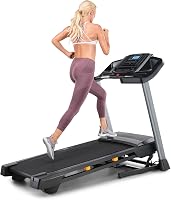
A 0 to 10% incline range, like the range on the NordicTrack T Series, lets you raise effort without raising belt speed. That choice can help when you want hill work but want to keep the pace math simple.
Keep the belt at 3.1 mph and change incline in small steps. Wait a minute after each change before you judge how it feels.
Your heart rate and breathing will tell you if the new grade is too much.
For readers who prefer incline walking, our best treadmill for seniors with incline guide covers models with lower steps and joint-friendly use.
Which treadmill features help you hold 3.1 mph comfortably?
Cushioning, a clear speed display, and a stable belt help you hold 3.1 mph for longer. Those features matter more than top speed for a steady walk.
KeyFlex cushioning on the NordicTrack T Series is made to reduce joint impact during walking or running. A 55 inch deck and 20 inch width give room for a natural stride, and the 5 inch LCD display shows live stats.
The frame folds and rolls away for small spaces. The 2.8 hp motor and 400 watt input power support regular home workouts in this speed range.
Who should choose the NordicTrack T Series?
Choose the NordicTrack T Series if you want a wide speed range plus incline and app-linked workouts. The T5, T6.5s, T7, T10, and T16 models share the home treadmill line in the title.
iFIT Train Membership is required for trainer-led workouts, SmartAdjust, and ActivePulse heart-rate control. Strava, Garmin, and Apple Health syncing also requires that membership.
If you do not want a membership, the LCD stats and manual controls still cover basic pace work.
When does a walking belt replacement matter for pace work?
A walking belt matters when the belt slips, feels dry, or shows wear that throws off your stride. A worn belt can make 3.1 mph feel uneven, even if the display number stays the same.
The SHEJIO belt is made for the Nordictrack T 6.5 S treadmill, models 250160 and 263241. It uses PVC material with a two-layer design and anti-static conductive wires.
It comes pre-lubricated, and SHEJIO says to add only a small amount of extra lubricant if needed.
Lubricate the belt at least once a year to reduce friction, according to SHEJIO. Too much lubricant can cause slipping, so use a small amount and test at low speed first.
Which compact treadmill suits a 3.1 mph walking pace at home?
A compact treadmill suits this pace if it covers 3.1 mph easily, folds away, and tracks time and distance. You do not need a 10 mph top speed for walking.
The ApexNexus runs from 0.6 to 6.2 mph, so 3.1 mph sits in the middle of its range. Its 3.0HP brushless motor is described as whisper-quiet, with noise below 50 dB, and it supports users up to 300 lb.
The LED display tracks speed, time, calories, and distance, and it auto-saves data when paused. Manual incline reaches 12%, with six-layer cushioning, and the frame folds down for storage.
This model suits apartments and small rooms where storage matters. Its 41 pound weight and folded size of 46.5 by 22.8 by 5.5 inches make it easier to move than larger home treadmills.
The tradeoff is a narrower 15 inch belt and manual incline.
What mistakes should you avoid with 12 minute kilometer speed?
Avoid mixing miles and kilometers, holding the rails, and jumping straight to 3.1 mph. Each mistake changes the pace or makes it feel harder than the math.
The biggest mistake is using 5.0 mph because that number matches 5.0 km/h. Those are not the same speed, and 5.0 mph is a 12 minute mile.
Check the unit on the display before every session.
Holding the handrails can hide balance issues and change your stride. Step on at low speed, let go when steady, and keep the safety key clipped on.
Raise the belt in small steps and give each step 20 to 30 seconds.
How does this pace fit into a simple training plan?
Use 3.1 mph for warm-ups, steady walks, and cool-downs, then add time before you add speed. That builds stamina without forcing a faster pace too soon.
Walk 10 minutes at 3.1 mph for 3 sessions in the first week. Extend to 15 minutes in the second week, then add 5 minutes per week until you can walk 30 minutes with steady breathing.
Later, add incline or short faster intervals for more challenge. Keep 3.1 mph as your base pace for recovery days.
Our Best Treadmill For Beginners guide can help if you are choosing a first machine for this plan.
Which treadmill should you pick for this pace?
Pick the NordicTrack T Series for a full home treadmill, or the ApexNexus for a compact folding option. The SHEJIO belt is a replacement part, not a complete treadmill.
Choose NordicTrack for 0 to 10 mph, 0 to 10% power incline, and app-linked training. Choose ApexNexus for 0.6 to 6.2 mph, 12% manual incline, and small-space storage.
Both cover 3.1 mph with room to spare.
NordicTrack suits buyers who want a larger machine with more features. ApexNexus suits buyers who want a lighter option that folds away after use.
If speed training is your later goal, our Best Treadmill For Speed Training guide compares higher-speed models. Set 3.1 mph or 5.0 km/h, walk for 12 minutes, and you will cover 1 kilometer.
Frequently asked questions
What treadmill speed equals a 12 minute kilometer?
Set 3.1 mph or 5.0 km/h for a 12 minute kilometer. The math is 60 minutes divided by 12 minutes per kilometer, which equals 5 kilometers per hour.
Most treadmills in the United States show mph, so use 3.1 mph and check distance in kilometers if your display allows it.
Is a 12 minute kilometer the same as a 12 minute mile?
No. A 12 minute mile is faster, at 5.0 mph.
A 12 minute kilometer is 3.1 mph because a kilometer is shorter than a mile.
Mixing the two units is the most common error in this conversion.
Does incline change the speed needed for 12 minute kilometer pace?
No. Incline changes effort and calorie burn, but speed still sets distance per hour.
Keep the belt at 3.1 mph and add incline only if you want more effort at the same pace.