9 Best Vibrating Foam Rollers (November 2026)
The best vibrating foam rollers include the Amazon Basics High-Density Foam Roller for Exercise for simple firm rolling, the BORNEW Foam Roller Set for a full kit on a budget, and the TriggerPoint CORE Foam Massage Roller with Softer for softer compression.
On this page (10 sections)
- Vibrating foam rollers compared by power, portability and texture
- Vibrating foam roller comparison at a glance
- How we compared these vibrating foam rollers
- How do vibrating foam rollers work on tight muscles?
- Is a vibrating foam roller worth it for legs and back?
- Are vibrating foam rollers portable enough for travel?
- What texture and firmness should you choose?
- How do kits compare with a single vibrating roller?
- How should you use a vibrating foam roller safely?
- Verdict: which vibrating foam roller should you buy?
The best vibrating foam roller for most people is the TheraGun Therabody WaveRoller, with 5 intensities and a wave texture for large muscle groups. The Vulken gives you a longer 17-inch surface and 4 modes, while the plain rollers here win on price, weight and simple firm pressure.
Our score weighs specs, features and buyer feedback against what you're shopping for. A powered roller scores well when its vibration settings, battery life and texture match the keyword search, and a plain roller can still score high when its density, size and kit value fit daily recovery.
Our picks at a glance
-
1
 Best for simple firm rolling
Amazon Basics High-Density Foam Roller for Exercise
9.7/10 our score
See it on Amazon -
2

-
3
 Best for softer compression
TriggerPoint CORE Foam Massage Roller with Softer
9.5/10 our score
See it on Amazon
- 4
 Check it
TriggerPoint Grid 2.0 Foam Roller for Deep
Best for textured pressure - 5
 Check it
TheraGun Therabody WaveRoller High-Density Vibrating Foam Roller
Best for vibration control - 6
 Check it
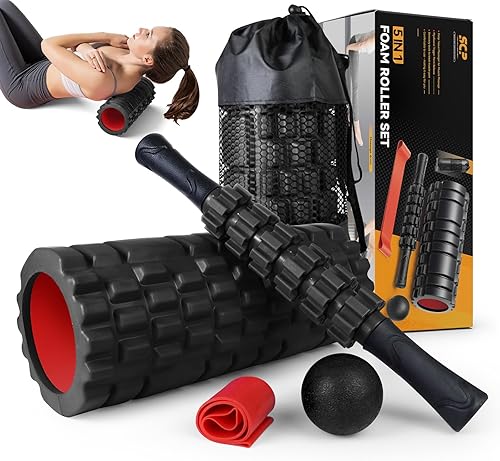
SUBCULTUREPICK 5 in1 Foam Roller Set
Best for nested storage - 7
 Check it
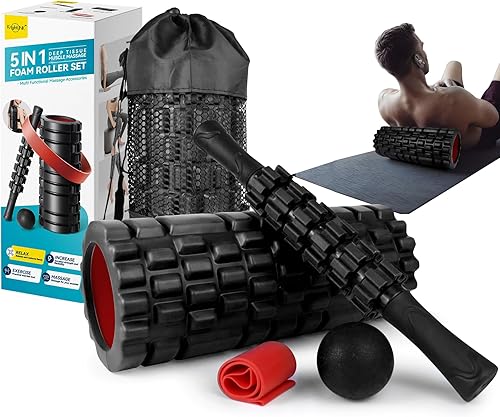
Krightlink 5-in-1 Foam Roller Set High Density
Best for deep tissue sets - 8
 Check it
Krightlink 5 in 1 Foam Roller Set
Best for runners and swimmers - 9
 Best for extra long coverageCheck it
Vibrating foam rollers compared by power, portability and texture
The best vibrating foam roller for you depends on how much vibration you want, how far you will carry it, and how textured the surface feels under your weight. Powered picks add settings and batteries, while plain picks add length, density and extra tools.
We compared 9 products by vibration settings, length, diameter, firmness, material, weight, included tools and storage. We checked the specs for each model, then matched them to who each product suits and what trade-off you accept.
Amazon Basics High-Density Foam Roller for Exercise: Best for simple firm rolling
- 18 x 6 x 6 inches
- Firm polypropylene
- Molded edges
- Wipes clean
A firm, lightweight 18-inch roller for balance, strengthening and recovery work. It has no vibration, so it suits buyers who want a plain, easy to carry tool.
Pros
- Firm and durable shape
- Lightweight at 0.27 kg
- Molded edges for comfort
Cons
- No vibration or texture zones
- Single piece only
This Amazon Basics roller suits people who want a plain, firm tool with no battery to charge. It measures 18 x 6 x 6 inches, so it gives you a long surface for legs and back while staying easy to move between rooms.
The foam is firm polypropylene that holds its shape for balance, strengthening and recovery exercises. Molded edges add comfort under your body, and the surface wipes clean after sweaty sessions.
It weighs only 0.27 kg, which makes it light to carry to class. You can also reposition it during a workout without much effort.
The trade-off is clear: there is no vibration and no textured zones. If you specifically want a powered roller, look at the TheraGun or Vulken picks lower in this guide.
BORNEW Foam Roller Set: Best for a full kit on a budget
- 12-inch high density roller
- 15-inch massage stick
- Peanut and spiky balls
- 78-inch stretching strap
- Nylon bag
A varied kit with a roller, stick, two balls, a strap, guide and bag. It suits buyers who want several tools for home, gym and travel.
Pros
- Many tools in one bag
- High density foam to 300 lb
- Portable nylon bag
Cons
- Roller is only 12 inches
- No powered vibration
This BORNEW set suits buyers who want variety more than vibration. You get a 12-inch high density roller, a 15-inch massage stick, a peanut ball, a spiky ball, a 78-inch stretching strap, a guide and a nylon bag.
The high density foam supports up to 300 lb and keeps its shape after heavy use. It also has no squeezing noise and repels liquids, which helps during long sessions.
The nylon mesh bag doubles as a yoga mat carrier, so the kit is easy to take to the gym or on a trip. Rolling before and after workouts fits a stretching routine for runners, players and yoga users.
The trade-off is size and power. The roller is only 12 inches, and none of the tools vibrate, so deep pressure comes from your own weight and the ball textures.
TriggerPoint CORE Foam Massage Roller with Softer: Best for softer compression
- Solid-core EVA foam
- Multi-density GRID pattern
- 18-inch versatile length
- Softer compression
A softer EVA roller with a multi-density pattern for self-massage and mobility work. The 18-inch length suits most muscle groups without the cost of power.
Pros
- Softer feel for new users
- Durable solid core
- Pattern gives targeted compression
Cons
- No vibration
- Firmness may be too soft for some
This TriggerPoint CORE roller suits newer users who find firm rollers too harsh. It uses solid-core EVA foam with softer compression and a multi-density GRID pattern for targeted pressure.
The versatile 18-inch length works for most muscle groups. That length gives you enough surface for quads, hamstrings and calves without needing to shift position often.
EVA foam is more durable than standard polypropylene rollers that can break down and feel soft over time. The solid core helps the roller keep its shape session after session.
The trade-off is firmness and power. Buyers who want deep, hard pressure may find this softer feel too gentle, and there is no vibration to add extra sensation.
TriggerPoint Grid 2.0 Foam Roller for Deep: Best for textured pressure
- 26-inch length
- Multi-density EVA surface
- Rigid hollow core
- Supports 500 pounds
A long textured roller with three foam zones for wide, tubular and fingertip style pressure. It suits back, hamstrings, quads, IT band and calves.
Pros
- Long 26-inch surface
- Three texture zones
- Holds shape under load
Cons
- Longer to store
- No vibration
This TriggerPoint Grid 2.0 suits buyers who want texture without a battery. Its patented multi-density surface has three zones that work like a palm, fingers and fingertips.
The 26-inch length gives full back coverage and more balance during use. It also works well for hamstrings, quads, IT band and calves because you need fewer passes to cover a large area.
A rigid hollow core wrapped in EVA foam keeps firmness consistent. TriggerPoint says it supports up to 500 pounds, so heavier users can press with more confidence.
The trade-off is storage and size. Compare 36-inch foam roller options if you want a longer roller for broader coverage.
At 26 inches, it takes more closet or car space than a 12-inch vibrating roller.
It also has no powered vibration, so pressure is all manual.
TheraGun Therabody WaveRoller High-Density Vibrating Foam Roller: Best for vibration control
- 5 vibration intensities
- Wave foam texture
- 12 x 5 inches
- 180 minutes of battery life
- Therabody app control
A vibrating roller with 5 intensities, wave grooves and app control for large muscle groups. It suits buyers who want adjustable power and a compact travel size.
Pros
- 5 vibration settings
- Wave texture adds pressure
- Compact 12-inch size
Cons
- Shorter than long rollers
- Heavier at 6.26 pounds
This TheraGun Therabody WaveRoller suits buyers who want control over vibration. It has 5 powerful vibration intensity settings that you can adjust through the Therabody app.
The wave foam texture adds another dimension of pressure while the silicone wave grooves improve traction control. EVA high-density foam also helps with sound insulation during a roll.
It measures 12 x 5 inches, which is compact enough for a gym bag or a shelf at home. The included protective carrying pouch and power adapter make travel simpler.
The internal lithium-ion battery gives 180 minutes of total life. That is enough for many short recovery sessions between charges.
The trade-off is length and weight. At 6.26 pounds, it is heavier than the 2.1-pound Vulken.
Its 12-inch length also covers less surface than a 17-inch or 26-inch roller.
SUBCULTUREPICK 5 in1 Foam Roller Set: Best for nested storage
- 13 x 5-inch hollow roller
- 15-inch muscle stick
- 2.5-inch massage ball
- 24 x 2-inch stretching band
- Storage bag
A 5-in-1 kit that nests inside a hollow roller and packs into a mesh bag. It suits runners and yoga users who want a stick, ball and band with the roller.
Pros
- Five tools in one kit
- Nests for gym bag storage
- Lightweight at 2 pounds
Cons
- 13-inch roller is short
- No vibration
This SUBCULTUREPICK set suits people who want five tools that pack into one bag. The package includes a 13 x 5-inch hollow foam roller, a 15-inch muscle stick, a 2.5-inch massage ball, a 24 x 2-inch stretching band and a storage bag.
The hollow core lets you tuck the stick, ball and band inside the roller. The whole set then fits into a mesh bag for the gym, a car trunk or a suitcase.
PVC and EVA materials give cushioning elasticity, and the set is light, pressure-resistant, waterproof and sweat-proof. It is also easy to clean after use.
The trigger point roller and stick help you control pressure by pressing with more or less force. The ball works well for shoulders, calves, groins and feet.
The trade-off is roller length and power. A 13-inch roller covers less area than longer picks, and there is no vibration for extra intensity.
Krightlink 5-in-1 Foam Roller Set High Density: Best for deep tissue sets
- 13-inch hollow roller
- 15-inch muscle stick
- 2.5-inch massage ball
- Resistance band
- Nylon mesh bag
A high density 5-piece kit for deep tissue work on legs, back and shoulders. The hollow roller stores the stick, ball and band for travel.
Pros
- High density EVA and PVC
- Complete 5-piece kit
- Compact nested storage
Cons
- Short roller length
- No powered option
This Krightlink set suits athletes who want a deep tissue kit for daily recovery. It includes a 13-inch hollow foam roller, a 15-inch muscle stick, a 2.5-inch massage ball, a resistance band and a storage bag.
Professional-grade PVC and EVA materials keep shape under a 200 lb load. The design is also waterproof, sweat-resistant and easy to clean.
The hollow roller stores the other tools inside, so the kit compresses for a gym bag or luggage. A premium nylon mesh carry bag keeps everything together at home or outdoors.
You can target quads, hamstrings, back, shoulders and calves with different pieces. The ball digs into knots, while the stick gives gentler pressure you can control.
The trade-off is length and power. The roller is only 13 inches, and the set has no vibration, so it is a manual recovery kit rather than a powered one.
Krightlink 5 in 1 Foam Roller Set: Best for runners and swimmers
- 13 x 5-inch hollow roller
- 15-inch muscle stick
- 2.5-inch massage ball
- 24 x 2-inch stretching band
- Storage bag
A lightweight 5-in-1 set for runners, athletes, yoga and Pilates users. It targets shoulders, arms, legs, back, thighs and calves after exercise.
Pros
- Waterproof and sweat-proof
- Lightweight and portable
- Varied tools for daily stretching
Cons
- 13-inch roller is compact
- No vibration
This Krightlink set suits runners, athletes, yoga and Pilates students, and swimmers. It includes a 13 x 5-inch hollow foam roller, a 15-inch muscle stick, a 2.5-inch massage ball, a 24 x 2-inch stretching band and a storage bag.
PVC and EVA materials give cushioning elasticity and help the roller keep its shape after heavy use. The set is also light, pressure-resistant, waterproof, sweat-proof and easy to clean.
A portable nylon mesh bag makes storage and transport simple. You can use the tools at home, in the gym or outdoors before or after exercise.
The pieces target shoulders, arms, legs, back, buttocks, thighs, hamstrings, quads and calves. That range suits post-workout stretching and daily muscle care.
The trade-off is roller size and power. At 13 inches, it is shorter than the 17-inch Vulken or 26-inch Grid 2.0, and it has no vibration settings.
Vulken Vibrating Foam Roller: Best for extra long coverage
- 17-inch extra long length
- 4 vibration modes
- Up to 3800 RPM
- 2.1 pounds
- Carrying bag
An extra long vibrating roller with 3 intensity levels plus auto-pulsating mode. It suits athletes who want wider coverage for back, legs, quads and calves.
Pros
- 17-inch long surface
- 4 vibration modes
- Lightweight at 2.1 pounds
Cons
- Firm EPP foam
- Battery details are general
This Vulken roller suits athletes who want long vibrating coverage. At 17 inches, it gives a wider massage surface than standard 12-inch rollers.
It has 4 vibration modes: low, medium and high, plus an auto-pulsating mode. That range lets you use gentle vibration for warm-ups and stronger vibration after workouts.
The motor delivers up to 3800 RPM for deep tissue massage. Vulken positions that power as a way to loosen tight muscles compared with a non-vibrating roller.
Premium EPP foam transfers vibration while keeping the roller light at 2.1 pounds. A carrying bag helps you move it between the gym, home and travel.
The trade-off is firmness and battery detail. The rechargeable battery is included, but total runtime is not stated in the same detail as the TheraGun pick.
EPP foam also feels firm, so test your tolerance at low intensity first.
Vibrating foam roller comparison at a glance
The TheraGun WaveRoller and Vulken are the only powered picks here, and they solve different problems. TheraGun gives you 5 intensities, app control and a wave texture in a compact 12-inch body, while Vulken gives you 17 inches and 4 modes at 2.1 pounds.
| Product | Best for | Size | Material | Firmness | Our score |
|---|---|---|---|---|---|
| Amazon Basics High-Density Foam Roller for Exercise | simple firm rolling | 18 x 6 x 6 inches | Polypropylene | Firm | 9.7 |
| BORNEW Foam Roller Set | a full kit on a budget | 9.7 | |||
| TriggerPoint CORE Foam Massage Roller with Softer | softer compression | Soft | 9.5 | ||
| TriggerPoint Grid 2.0 Foam Roller for Deep | textured pressure | 9.3 | |||
| TheraGun Therabody WaveRoller High-Density Vibrating Foam Roller | vibration control | 12 x 5 inches | 9.2 | ||
| SUBCULTUREPICK 5 in1 Foam Roller Set | nested storage | 8.8 | |||
| Krightlink 5-in-1 Foam Roller Set High Density | deep tissue sets | 8.5 | |||
| Krightlink 5 in 1 Foam Roller Set | runners and swimmers | PVC and EVA | 8.3 | ||
| Vulken Vibrating Foam Roller | extra long coverage | 8.1 |
For vibration settings, TheraGun lists 5 intensities and Vulken lists 3 intensity levels plus auto-pulsating mode. For portability, Vulken wins on weight at 2.1 pounds, while TheraGun wins on compact shape and its carrying pouch.
For surface texture, TheraGun uses wave grooves, and Vulken uses a firm EPP surface without the same groove pattern.
Plain rollers win when you want length, density or extra tools. The Grid 2.0 is 26 inches with three texture zones, the Amazon Basics roller is 18 inches and firm, and the 5-in-1 sets add a stick, ball and band for targeted work.
How we compared these vibrating foam rollers
We compared vibration settings first, since that is why most buyers search for a vibrating foam roller. We checked how many intensities or modes each powered model offers and how control works, by app, button or mode dial.
We then compared portability by length, diameter and weight. A 12-inch roller fits a gym bag more easily than a 26-inch roller, while a 17-inch roller covers more muscle per pass but needs more storage.
We also compared texture, firmness and included tools. Wave grooves, GRID zones and smooth firm foam each change pressure, so we matched texture to muscle group size.
Large groups like quads and back suit longer or textured surfaces, while small areas suit a ball or stick from a kit such as those from BORNEW, SUBCULTUREPICK and Krightlink for shoulders, calves, groins and feet.
Our score weighs specs, features and buyer feedback. Powered rollers score on settings, battery life and texture, while plain rollers score on density, length, weight and kit value.
How do vibrating foam rollers work on tight muscles?
A vibrating foam roller combines pressure from your body weight with vibration from a motor. The vibration adds sensation and may help you tolerate pressure on tight areas, especially at a low setting.
TheraGun says its 5 intensities can be adjusted to your comfort level to help release soreness, reduce tension and increase range of motion. Vulken says its motor up to 3800 RPM helps loosen tight muscles for deep tissue massage.
Use vibration as a guide, not a goal. Start low, roll slowly over large muscles, and raise intensity only when it stays comfortable.
Sharp pain means stop, and ongoing pain deserves a check with a doctor.
Is vibration better than firm pressure alone?
Vibration can make pressure feel stronger without you pressing harder. That helps some buyers use a roller for shorter sessions before and after workouts.
Firm pressure alone is simpler and quieter. A firm plain roller also has no battery, no motor noise and no charging cable to carry.
What should beginners expect from vibration?
Beginners should expect a buzzing sensation that changes with speed. The TheraGun app helps you change intensity without reaching for a dial, while Vulken's modes change by preset.
Start with the lowest setting on quads or hamstrings. Keep sessions short at first, then add time as you learn which muscles feel better with more power.
Is a vibrating foam roller worth it for legs and back?
Yes, it can be worth it if you roll large muscle groups often and want powered help. Legs and back cover a wide area, so a longer surface or a textured surface saves time.
The Vulken's 17-inch length targets back, legs, quads, hamstrings and calves in fewer passes. The Grid 2.0's 26-inch length also suits the back, hamstrings, quads, IT band and calves, but without vibration.
For a focused routine, see our best foam roller for legs guide. It helps you match roller length and firmness to the muscles you roll most.
Which length suits legs best?
A 17-inch or 26-inch roller suits legs because you can cover quads and hamstrings with fewer shifts. That length also helps balance when you roll one leg at a time.
A 12-inch or 13-inch roller is easier to carry, but you will move it more often. Choose short if travel matters more than coverage.
Do you need vibration for your back?
Vibration can help some buyers tolerate pressure across the mid and lower back. Keep it away from the spine and use a low setting at first.
A textured plain roller can also work well for the back. The Grid 2.0's three zones give palm, finger and fingertip style pressure without a battery.
Are vibrating foam rollers portable enough for travel?
Portability depends on length, weight and whether the roller is hollow. A short powered roller with a pouch fits a gym bag, while a long plain roller needs more space in a car or closet.
The TheraGun WaveRoller is 12 x 5 inches with a protective carrying pouch. It weighs 6.26 pounds, so it is compact but not light.
The Vulken weighs 2.1 pounds and includes a carrying bag. Its 17-inch length is longer to pack, but its low weight helps on trips.
Kits add another kind of portability. The SUBCULTUREPICK and Krightlink sets nest a stick, ball and band inside a hollow roller, then pack into a mesh bag.
For a smaller travel option, compare our best mini foam roller picks. A mini roller will not vibrate like these powered models, but it is easier to carry.
What should you pack for the gym?
Pack the roller, a water bottle and any ball or stick you use most. A mesh bag keeps small tools from rolling loose in a larger bag.
Check the battery before you leave if you use a powered roller. The TheraGun gives 180 minutes of total life, while Vulken uses a rechargeable battery with a charging system included.
How do you store a long roller at home?
Store a 17-inch or 26-inch roller flat in a closet or behind a door. Keep it away from heat and direct sun so the foam keeps its shape.
Wipe EPP, EVA and polypropylene surfaces with a damp cloth. Let the roller dry before putting it back in a bag or pouch.
What texture and firmness should you choose?
Texture changes pressure more than most buyers expect. A smooth firm surface spreads pressure evenly, while grooves and zones concentrate pressure in lines and spots.
The TheraGun wave texture adds pressure through silicone wave grooves. The Grid 2.0 uses three foam zones that mimic a palm, fingers and fingertips.
The CORE roller uses a multi-density GRID pattern with softer compression.
Firmness matters for tolerance. The Amazon Basics roller is firm polypropylene, the Vulken is firm EPP foam, and the CORE roller is soft EVA foam.
Softer foam suits new users, while firm foam suits buyers who want deep pressure.
If you want a plain firm option in a smaller size, read about a high density foam roller 4 inch. That size is easier to carry but covers less area.
Is a textured roller better for trigger points?
A textured roller can help you find tight spots because the pattern changes pressure as you roll. The Grid 2.0 and CORE rollers both use patterned surfaces for that reason.
A massage ball is often better for a single spot. The 5-in-1 kits include a 2.5-inch ball for shoulders, calves, groins and feet.
Should you choose soft or firm foam?
Choose soft if you are new, sensitive or rolling often. The CORE roller gives softer compression for self-massage and mobility work.
Choose firm if you want strong pressure and a roller that holds shape. Firm rollers in this guide include the Amazon Basics, Vulken and Krightlink sets.
How do kits compare with a single vibrating roller?
A kit gives you more tools, while a vibrating roller gives you powered pressure. The best choice depends on whether your tight spots are wide areas or small, hard to reach spots.
The BORNEW kit adds a stick, peanut ball, spiky ball and stretching strap to a 12-inch roller. The SUBCULTUREPICK and Krightlink kits add a stick, ball and band to a 13-inch hollow roller.
Those extra tools suit our best stretching strap with loops style stretching, but the strap in these kits is a simple band. A stick helps you control pressure on arms and legs without putting your full weight on the tool.
A calf stretcher tool solves a different problem for calves, so compare that tool if stretching is your main goal. A roller or ball is better for pressure, while a stretcher targets range of motion.
Can a kit replace a massage gun?
A kit is not a replacement for a massage gun. A massage gun uses percussion on a small area, while a roller uses broad pressure across a muscle.
Many buyers use both tools for different jobs. A roller suits quads, hamstrings and back, while a gun suits small areas where you want focused percussion.
Which attachments pair well with rolling?
A massage gun attachment can reach spots a roller cannot. Our best massage gun attachments guide helps you match heads to muscle groups.
Use the roller first for broad pressure, then use a gun head for a small knot. Keep both tools at a low setting at first and stop if pain gets sharp.
How should you use a vibrating foam roller safely?
Start with a low vibration setting and slow movement. Keep the roller on muscle, not on joints, the spine, the neck or bony areas.
Roll for short sessions at first, then adjust time and intensity as you learn your tolerance. TheraGun says its intensities can be adjusted to your comfort level, which is a useful rule for any powered roller.
For overall recovery routines, our best foam roller for recovery guide covers plain rollers in more depth. Use that guide if you decide vibration is not worth the battery and weight.
Do you need to charge before each use?
Charge a powered roller when the battery runs low, not necessarily before each session. The TheraGun battery gives 180 minutes of total life, so many short sessions fit between charges.
Keep the charger or adapter with the roller during travel. That habit prevents a dead battery at the gym.
When should you skip rolling?
Skip rolling over an injury, a recent surgery site or an area with sharp pain. Talk with a doctor about ongoing pain, numbness or swelling.
Rolling is for general muscle care, not treatment. If pain lasts more than a few days or gets worse, get medical advice.
Verdict: which vibrating foam roller should you buy?
Pick the TheraGun Therabody WaveRoller if you want the best vibrating foam roller with adjustable power. Its 5 intensities, wave texture and app control suit large muscle groups in a compact 12-inch size.
Pick the Vulken if you want longer coverage and a lighter roller. Its 17-inch length, 4 modes and 2.1-pound weight suit athletes who roll legs and back often.
Pick a plain roller or kit if you want simple firm pressure, lower weight or more tools. The Amazon Basics roller is firm and light, the Grid 2.0 is long and textured, and the 5-in-1 sets add a stick, ball and band for targeted work.
Match your main muscle group to roller length before you buy. Then choose vibration for powered help, or density and texture for a plain tool that is easy to carry.
Our top 3 picks at a glance
-
1
Best for simple firm rolling
Amazon Basics High-Density Foam Roller for Exercise
9.7/10 our score
See it on Amazon -
2
-
3
Best for softer compression
TriggerPoint CORE Foam Massage Roller with Softer
9.5/10 our score
See it on Amazon
Frequently asked questions
What is the best vibrating foam roller for beginners?
The TheraGun Therabody WaveRoller suits beginners because its 5 intensities let you start low and raise power as you learn your tolerance. Its 12-inch size is also easy to store.
Start with short sessions on large muscles, then adjust settings slowly.
Is a vibrating foam roller better than a regular foam roller?
A vibrating foam roller adds adjustable vibration to pressure, which many buyers find useful for tight muscles. A regular roller is lighter, quieter and cheaper to carry.
Choose vibration if you want powered help, and choose a plain roller if you want simple, firm pressure.
How long should a foam roller be?
Length depends on the muscle group you roll most. A 17-inch or 26-inch roller covers the back and legs in fewer passes.
A 12-inch or 13-inch roller is easier to carry.
Long rollers help balance, while short rollers help travel.
Can you use a vibrating foam roller on your calves?
Yes, calves are a common area for rolling because they are large and easy to reach. Use a low intensity at first, then raise it only if the pressure feels comfortable.
Stop if you feel sharp pain, and talk with a doctor about ongoing pain.