How to Choose Adjustable Dumbbells up to 90 lbs
Choose adjustable dumbbells up to 90 lbs by checking per-hand capacity first, then expansion stages, adjustment speed, grip, storage and the exercises you plan to do. A set rated for 90 lbs usually means 90 lbs in each hand, not 90 lbs for the pair.
On this page (9 sections)
- What does “up to 90 lbs” mean?
- How do expansion stages work?
- Which adjustment style is best for heavy training?
- How much weight do you need for each exercise?
- What should you check about grip and balance?
- Do you need a pair or one adjustable dumbbell?
- Are adjustable dumbbells better than kettlebells?
- How should you store and care for adjustable dumbbells?
- What is the best way to choose adjustable dumbbells up to 90 lbs?
Adjustable dumbbells up to 90 lbs make sense when you need heavy resistance without filling a room with fixed dumbbells. Start by confirming whether the advertised capacity is per hand, then check how the set reaches that weight and whether both dumbbells are included.
That first check shapes everything else. A per hand rating tells you the most one dumbbell can carry, while a total set rating spreads that weight across both handles and all loose parts.
A set that reaches 90 lbs in each hand gives you more room for presses, rows, squats and lunges than a lighter pair. It also gives you room to grow, since you can add load slowly instead of stopping at a fixed ceiling.
If your target is below that limit, a smaller set may be easier to store and faster to adjust. It can also mean a shorter handle, fewer plates to move, and a case or rack that fits in a corner.
This category suits people whose main lifts are already near a lighter set limit. It suits them less if most work is light isolation exercises or training in a very small space.
Paying for capacity you never use can add weight, size and cost without improving workouts.
Consider set up before you order, not after. Decide where the dumbbells will live, how you will carry them into position, and where unused plates or expansion parts will go.
A stable floor spot near your bench or mat keeps changes simple. It also keeps collars, plates and dials together, which matters more when parts are heavier and harder to replace.
Care starts with the same habit. Return plates to their case, keep handles dry, and check collars or locks before each lift so nothing shifts mid set.
Heavy adjustable sets save floor space compared with a full rack, but they rarely match the speed or feel of fixed weights in every case.
For a wider overview of home strength choices, see our guide to resistance bands. If you want product comparisons before choosing a capacity, read our guide to the best adjustable dumbbells for home gym.
What does “up to 90 lbs” mean?
“Up to 90 lbs” should mean the maximum weight of one dumbbell, but product formats vary. Read the capacity as a per-hand number only when the product clearly describes one dumbbell reaching that weight.
A pair rated at 90 lbs per hand can provide up to 180 lbs total. That matters for exercises such as dumbbell presses, where you may use both hands at the same time.
Some products use expansion stages. You might begin with a lower weight, add heavier plates or components later, and eventually reach the maximum.
Other sets arrive at one fixed maximum and adjust within that range.
Before you choose, write down these 5 details:
- Starting weight
- Maximum weight per dumbbell
- Number of dumbbells included
- Included adjustment parts
- Expansion parts required for the maximum
Do not assume that a product with “90 lbs” in its name includes 2 dumbbells at 90 lbs each. The difference affects your budget, storage plan and training options.
How do expansion stages work?
Expansion stages let you build toward a heavier set instead of buying the largest configuration immediately. Compare the total path from the starting stage to 90 lbs, including what is included now and what you must add later.
An expansion plan can work well if your strength goals are gradual. It also helps you avoid storing heavy components before you need them.
Check whether each stage adds plates, handles, collars, a longer loading area or a separate conversion part. The exact design depends on the set, so use the product's included parts and maximum capacity as your guide.
A useful buying sequence looks like this:
- Pick the weight you can use safely for your main exercises.
- Check the next available expansion stage.
- Confirm that the heavier stage reaches the capacity you want per hand.
- Confirm whether the expansion applies to one dumbbell or a pair.
- Plan where unused plates and components will be stored.
If your goal is closer to 100 lbs per hand, compare the next capacity range in our guide to adjustable dumbbells 100 lbs. If 90 lbs is more than you need, our guide to adjustable dumbbells up to 80 lbs may be a better fit.
Which adjustment style is best for heavy training?
The best adjustment style depends on whether you value faster changes or simpler loading. Quick-adjust systems reduce setup time, while plate-and-collar systems make each weight change more visible and manual.
A quick-adjust design can help when your workout moves between different exercises. You select the desired resistance, then continue without handling several loose plates.
A plate-and-collar system gives you direct control over the pieces on the handle. It can suit buyers who prefer a straightforward loading process and a storage case for the parts.
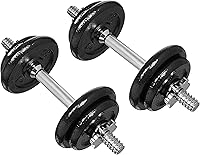
The Amazon Basics Adjustable Dumbbell Hand Weight Set uses sliding plates and threaded collars. Its set includes 2 dumbbells with 3 lb handles, four 2.5 lb plates, four 5 lb plates and four 0.5 lb collars, for 38 lbs total.
The black storage case has a carry handle.
The Lifepro Adjustable Dumbbells & Weights for Home uses a quick-adjust dial and offers weight levels from 5 to 25 lbs in 2.5 lb increments in the described pair set. Lifepro also describes options from 2 to 55 lb in single or pair formats, so check the selected format and capacity before ordering.
Neither example reaches 90 lbs per hand. They show the main adjustment trade-off, though: manual plates offer visible loading changes, while a dial is designed for faster selection.
How much weight do you need for each exercise?
Choose capacity based on the heaviest exercise you plan to progress, not the lightest exercise in your routine. For lighter wearable resistance during walking or leg work, compare ankle weights with metal bars.
Rows, presses, lunges and squats often need different weights, so leave room between your current working weight and the set's maximum.
For isolation work, such as curls or shoulder exercises, you may use a smaller load. For lighter fixed weights, see neoprene dumbbell sets.
For compound movements, you may want more capacity per hand, especially if dumbbells are your only heavy strength equipment.
A home adjustable weight bench can support presses and rows.
Think in stages:
- Light stage: warm-ups, smaller muscle groups and technique work
- Middle stage: curls, presses, rows and lunges
- Heavy stage: chest presses, split squats, goblet-style movements and heavier rows
- Maximum stage: the heaviest controlled work you expect to perform
A 90 lb maximum does not mean you should train at 90 lbs immediately. It means the set has more room for progression if the design, grip and adjustment method remain suitable as the load increases.
Also check whether the dumbbell becomes longer or wider at higher weights. A heavier adjustable dumbbell can change the path of a press or row if the plates extend far from your hand.
What should you check about grip and balance?
Grip and balance matter more as weight increases. Look for a handle diameter, handle material and loading design that you can hold securely through the exercises you plan to do.
A handle that feels fine at light weight can feel very different when plates push the total toward 90 lbs. Diameter affects how much of your hand wraps the bar, and material affects how the surface feels when your palms are warm or damp.
Loading design matters too, because wide plates can change the balance point. A dumbbell that feels steady in a curl can feel awkward in a press if the weight sits far from your grip.
The Amazon Basics 38 lb set has 1 in alloy steel handles. Its threaded collars secure the plates after you slide them into position.
That setup suits buyers who like to see each plate in place. You can check the stack visually, tighten each collar by hand, and store the plates in the case when you are done.
The Lifepro pair has 1 in alloy steel handles, a textured non-slip grip and a secure locking mechanism. Its stated dimensions are 13.6 in long by 6.7 in wide.
Texture can help during repeated reps, especially when you move quickly between exercises. A locking mechanism also gives you a clear check before you lift, rather than relying on collar tension alone.
Those details do not tell you exactly how every heavier adjustable set will feel. They do give you a checklist for comparing the handle and the adjustment area before buying.
Use that checklist in daily practice. Hold the handle as you would for a press, then for a row, and notice whether the adjustment parts press into your hand or crowd your knuckles.
Keep the dumbbells level during changes. Tighten collars or confirm the locking mechanism before each set, and stop using any component that does not sit securely.
Do you need a pair or one adjustable dumbbell?
Buy a pair when your program includes presses, rows, lunges or other movements where both arms or legs work together. Buy one dumbbell when your training is built around single-arm work or when you want to start with a smaller setup.
A pair also lets you keep the same weight in both hands. That can make loading simpler for exercises where balanced resistance matters.
The Lifepro product data describes a 25 lb pair set with 2 pieces and also mentions single or pair options. Confirm the selected format because one dumbbell and a pair support different workouts.
The Amazon Basics set is a set of 2 dumbbells with 38 lbs total. Its components divide across the pair, so the total number does not mean each dumbbell reaches 38 lbs.
Use this rule:
- Choose one if you mainly do single-arm rows, carries or split movements.
- Choose a pair if you do presses, bilateral rows, lunges or two-handed curls.
- Choose an expansion path only after confirming the final number of dumbbells.
Are adjustable dumbbells better than kettlebells?
Adjustable dumbbells are usually better for gradual loading and exercises that use 2 separate weights. A kettlebell is better when you want an offset handle for swings, carries, agility work or cardio-focused strength sessions.
Compare adjustable competition kettlebells for that format.
The choice comes down to movement, not just weight. Dumbbells let each hand follow its own path, which helps with presses, rows, lunges and split work where balance between sides matters.
A kettlebell places the weight below and beyond the handle, which changes the feel of every rep. That offset design suits hinge and swing patterns, where the weight moving away from the body is part of the exercise.
For gradual loading, adjustable dumbbells have a clear edge. You can raise the load in small steps, match both sides, and keep using one tool across many exercises.
A fixed kettlebell does not adjust at all, so progress means adding another weight or choosing a different tool for heavier work. That can still suit people who like simple, ready to lift equipment with no set up.
The Amazon Basics Vinyl Kettlebell is a 15 lb solid cast iron weight with a pink vinyl coating. It has a flat base, a textured wide curved handle and weight markings on both sides.
The flat base helps it sit still on the floor, and the coating is described as protecting floors, reducing noise and preventing corrosion. The wide curved handle can be held with one hand or two, which suits carries and many two hand movements.
Care for a coated kettlebell is simple in daily use. Keep it dry, set it down under control, and use the flat base for storage so it does not roll or tip.
It is not an adjustable dumbbell and does not expand to 90 lbs. It is useful as an alternative when your workout needs one fixed kettlebell rather than a pair of adjustable weights.
It is not an adjustable dumbbell and does not expand to 90 lbs. It is useful as an alternative when your workout needs one fixed kettlebell rather than a pair of adjustable weights.
Read our comparison of adjustable dumbbells or kettlebells if your routine includes both traditional dumbbell exercises and kettlebell movements.
How should you store and care for adjustable dumbbells?
Store adjustable dumbbells where plates, collars and handles stay together. A stable storage spot reduces missing parts and keeps your next weight change simple.
A carry case helps with the Amazon Basics 38 lb set because the case is designed for compact storage and transport. Keep the plates and collars in their assigned space after each session.
For dial-based sets, return the dumbbell to its rack or storage position after use if one is included with your selected format. Keep adjustment areas clear of loose items and avoid forcing a dial or locking mechanism.
Use these general habits:
- Set the dumbbell down under control.
- Check collars or locks before lifting.
- Keep plates and handles dry.
- Do not mix parts from unrelated adjustable sets.
- Recheck the selected weight after changing it.
- Leave enough floor space to lift and return the dumbbell safely.
For heavier sets, plan the storage location before buying. A 90 lb per-hand setup can require more room than a light compact pair, especially if expansion plates remain outside the handles.
What is the best way to choose adjustable dumbbells up to 90 lbs?
Choose adjustable dumbbells up to 90 lbs when you need heavy per-hand capacity and have a clear progression plan. Confirm the maximum per dumbbell, whether you are buying one or a pair, and which expansion stages are included.
That plan should start with your heaviest planned exercise, not your lightest. List the presses, rows, squats and lunges you want to progress, then match the per hand maximum to the top end of that list.
Pick a manual plate-and-collar design if you want visible loading changes and a storage case. Pick a quick-adjust design if fast changes matter more, while checking the exact selected capacity and format.
Manual loading suits people who train in one spot and do not mind handling plates. You see the load, you control the stack, and you can store parts in a case after each session.
Quick adjust suits people who move between exercises or train in circuits. A dial reduces handling, but you still need to confirm the selected weight and lock before each set.
A 38 lb total set can suit lighter home strength work, while a 25 lb pair can suit quick-adjust training at lower resistance. A 15 lb kettlebell is the better match for fixed-weight kettlebell movements.
Use the Amazon Basics example to judge format carefully. It is a set of 2 dumbbells with 38 lbs total, so the total does not mean each dumbbell reaches 38 lbs on its own.
Use the Lifepro example to judge speed and increments. It is described as a pair that adjusts from 5 to 25 lbs in 2.5 lb increments, which suits frequent changes at lower loads.
Neither example reaches the heavy ceiling in this guide. That gap matters, since a set that tops out early will limit presses and rows even if it is easy to store now.
Set up matters as much as specs. Plan floor space for the dumbbells at full load, plus room for plates, collars or a rack when parts are off the handle.
Care is part of the choice too. Keep handles and adjustment areas dry, check collars or locks before lifting, and store parts together so the next change stays simple.
The final decision is simple: choose the smallest setup that covers your current exercises, then verify that its expansion path reaches the per-hand capacity you actually need.
Frequently asked questions
Are adjustable dumbbells up to 90 lbs 90 lbs per hand?
Usually, a dumbbell rating describes the weight of one dumbbell, but you should confirm the set format before buying. A pair rated up to 90 lbs per hand gives you 180 lbs across both hands.
A 90 lb total set gives you much less resistance for two-handed exercises.
What does expansion-ready adjustable dumbbell mean?
Expansion-ready adjustable dumbbells are designed to grow through added stages or heavier components. Check the starting weight, maximum weight, included parts and final per-hand capacity.
A set that reaches 90 lbs only after expansion is different from one that includes every stage in the box.
Are adjustable dumbbells good for heavy presses and rows?
They can suit heavy presses and rows when the final per-hand capacity, handle shape and adjustment system match your training. Confirm that both dumbbells can reach the weight you need, since some sets are sold as one dumbbell and others as a pair.
Should I buy adjustable dumbbells or a kettlebell?
Choose adjustable dumbbells for exercises that need two separate weights and gradual loading. Choose a kettlebell for swings, carries and other movements built around one offset weight.
Your exercise list matters more than the word adjustable.