How to Use Resistance Bands for Upper Body
Use resistance bands for upper body workouts by anchoring or holding them securely, then combine presses, rows, raises, curls, and extensions. Start with controlled reps and choose resistance that lets you keep good form.
On this page (7 sections)
- How should you set up resistance bands for upper body workouts?
- Which upper body movements work with resistance bands?
- How do you do a resistance band upper body workout without an anchor?
- How do you progress with resistance bands?
- What is a simple resistance bands upper body workout?
- How do you care for and store workout bands?
- What should you choose for upper body training?
Use resistance bands for upper body workouts by combining pushes, pulls, raises, curls, and extensions into a balanced session. Secure the band, choose manageable tension, and keep each repetition slow enough to control.
A useful upper body session does not need many exercises. Pair one pushing movement with one pulling movement, then add work for the shoulders and arms.
If you are choosing equipment first, compare resistance bands with other home strength tools. A band can take little storage space, while a dumbbell gives you a fixed load for each exercise.
How should you set up resistance bands for upper body workouts?
Set the band so it cannot slide, snap toward you, or change position during the movement. Hold a loop band with both hands for exercises that do not need an anchor, or use a suitable anchor point only when the band and setup are designed for it.
To compare loop bands with handle based options, read resistance bands vs tubes.
Before each set, inspect the band for visible damage and check that your hands have a firm grip. Keep your face and other people away from the band's direct path.
Your stance also affects control. Stand with your feet about hip-width apart for balance, keep your ribs stacked over your hips, and avoid leaning back to create momentum.
For a closer look at movement choices, see these resistance bands exercises. Choose exercises that match the band shape you own instead of forcing a movement that needs different equipment.
Which band suits a simple upper body session?
A 3-band set can suit someone who wants a compact starting point and several resistance levels. Compare more options in the best resistance bands for home workouts.
The Renoj Fabric Resistance Bands for Working Out include 3 exercise bands, 3 resistance levels, a carry bag, and a stated tension supported of 35 lb.
The Renoj set is made from cotton and polyester and weighs 12.7 oz. Its dimensions are 28.35 in L x 3.15 in W, so it may suit people who prefer loop bands rather than a long band with handles.
Its stated uses include body building, exercise and fitness, Pilates, yoga, and strength training. The non-slip feature can help you focus on the movement, but you should still check the band position before every set.
Which upper body movements work with resistance bands?
Use a balanced mix of horizontal pushing, horizontal pulling, shoulder work, and arm work. This gives your session a clear structure without requiring a long list of exercises.
Try these movement groups:
- Chest press or band push-out for pushing.
- Standing row for pulling.
- Overhead press for the shoulders.
- Lateral raise for the side shoulders.
- Biceps curl for the front of the upper arm.
- Triceps extension or press-down for the back of the upper arm.
For a chest-focused session, use the movement ideas in this resistance bands chest workout. Keep the band close to the line of movement, and do not let it pull your shoulders forward at the end of each repetition.
A simple starting plan is 2 or 3 sets of 8 to 15 controlled repetitions per exercise. Use fewer repetitions if the band makes you lose control, and rest long enough to repeat the next set with steady form.
How do you do a resistance band upper body workout without an anchor?
Hold the band with both hands and use your stance to create tension. This approach works well for presses, pull-aparts, curls, raises, and some overhead movements.
For a standing chest press, hold the band behind your upper back and press both hands forward. Keep your wrists straight and stop before your shoulders roll forward.
For a row, hold the band in front of you, create tension by moving your hands apart, and pull your elbows back. Keep the movement smooth instead of jerking the band toward your body.
For a pull-apart, hold the band at chest height and separate your hands until your upper back works. Use a lighter level if your shoulders lift toward your ears.
Fabric loop bands can work well for simple held movements, but their loop shape may not suit every anchored exercise. If you want several levels for progression, the Vergali Resistance Bands for Working Out include 4 fabric bands with light, medium, strong, and heroic resistance levels.
Vergali lists the resistance ranges as light 14 to 25 lb, medium 25 to 35 lb, strong 25 to 45 lb, and heroic 45 to 60 lb. The set measures 13.6 in L x 3.15 in W and weighs 0.5 kg.
The set includes a carry bag and training guide. Vergali also describes the bands as non-slip and suitable for use over clothes or on bare skin, with uses that include strength training, yoga, and Pilates.
How do you progress with resistance bands?
Progress when you can finish your planned repetitions without changing your posture or speed. Move to a stronger band, add a few repetitions, increase the number of sets, or slow the lowering phase.
Use one change at a time. If you increase resistance and repetitions together, it becomes harder to tell which change caused the session to feel too difficult.
You can also make a movement harder by increasing the band's starting tension. Leave enough room to complete the full movement, because a starting position that is too tight can shorten your range and encourage compensation.
Resistance bands and weights create different training demands. Read resistance bands vs weights before deciding whether one tool or a combination fits your routine.
When should you add dumbbells?
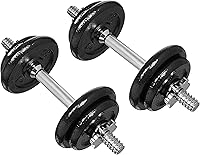
Dumbbells can help when you want a fixed load for hand-focused movements such as curls, presses, and raises. The Amazon Basics Neoprene Dumbbell Hand Weights are a pair of 10 lb hand weights with navy blue neoprene coating, hexagon-shaped ends, and nonslip grip.
The dumbbells have cast iron and PVC handles, measure 8.6 in L x 4.02 in W, and have no-roll heads. Their printed weight number and color-coded identification can make it easier to tell the pair apart from other sizes.
Choose them when a fixed 10 lb pair suits your current exercises. Choose bands when you want changing tension through the movement, compact storage, or several resistance levels in one setup.
What is a simple resistance bands upper body workout?
A simple session can use 5 movements and take about 20 to 30 minutes. Start with a warm-up, perform the exercises in order, and finish with gentle movement rather than forcing a stretch.
Try this structure:
- Band chest press, 2 sets of 8 to 12 reps.
- Standing row, 2 sets of 8 to 12 reps.
- Band pull-apart, 2 sets of 10 to 15 reps.
- Biceps curl, 2 sets of 8 to 15 reps.
- Triceps extension, 2 sets of 8 to 15 reps.
Rest between sets and keep the same controlled pace from the first repetition to the last. If the band becomes difficult to control, reduce the tension or stop the set.
You can alternate the first two movements as a push and pull pair. This keeps the routine organized and helps you cover the main upper body movement patterns without adding unnecessary exercises.
How do you care for and store workout bands?
Store bands away from sharp edges, direct heat, and anything that can cut or weaken the material. Keep them clean and dry, and avoid leaving them stretched for long periods between sessions.
A carry bag can make storage easier. The Renoj set and Vergali set both include carry bags, so they may suit people who move equipment between home, a gym, an office, or travel.
Do not use a damaged band for a hard set. Replace it if you see a split, tear, or other change that could affect control.
What should you choose for upper body training?
For resistance bands how to use upper body training, begin with a band that lets you complete controlled presses, rows, raises, curls, and extensions. Choose Renoj for a 3-band fabric loop set, Vergali for 4 resistance levels plus a training guide and carry bag, or Amazon Basics for a fixed pair of 10 lb neoprene dumbbells.
Use bands for portable, adjustable tension and dumbbells for a fixed hand load. If you want another full explanation of band technique, continue with how to exercise with resistance bands.
A steady routine, safe setup, and gradual progression matter more than adding many movements. Stop when your form changes, and adjust the exercise to the equipment you can control.
Frequently asked questions
How do you use resistance bands for upper body workouts?
Use a band for pulling, pressing, curling, raising, and extending movements. Hold or anchor it securely, keep the band aligned with the joint you are training, and use slow repetitions through a comfortable range.
Start with light resistance and stop if the band slips or your form changes.
Can resistance bands build upper body strength?
Resistance bands can make upper body movements harder by increasing tension as you pull them. They suit rows, presses, curls, extensions, and raises, but your results depend on consistent training, enough resistance, controlled movement, and recovery.
Add resistance gradually when you can complete every rep with good form.
Are fabric bands good for upper body workouts?
Fabric loop bands can help with selected upper body exercises, especially movements where you hold the band or use it around the arms. Their loop shape may limit some anchored exercises compared with long bands with handles.
Check the band length, resistance levels, and intended use before building a full routine.
How often should you do resistance bands upper body workouts?
Start with 2 or 3 upper body sessions per week, leaving recovery time between hard sessions. Use a mix of pushing and pulling movements, and avoid training through sharp pain.
A shorter session done consistently is easier to manage than a long routine that makes your form break down.